Embarking on a linguistic odyssey, we delve into the captivating question of what language does India speak. India, a nation of extraordinary linguistic diversity, is a mosaic of languages, each carrying its unique cultural and historical significance.
With over 122 major languages and 1500 dialects, India’s linguistic landscape is a testament to its rich cultural heritage. Hindi, the most widely spoken language, serves as the lingua franca, while English, the associate official language, plays a significant role in government, education, and business.
Languages Spoken in India

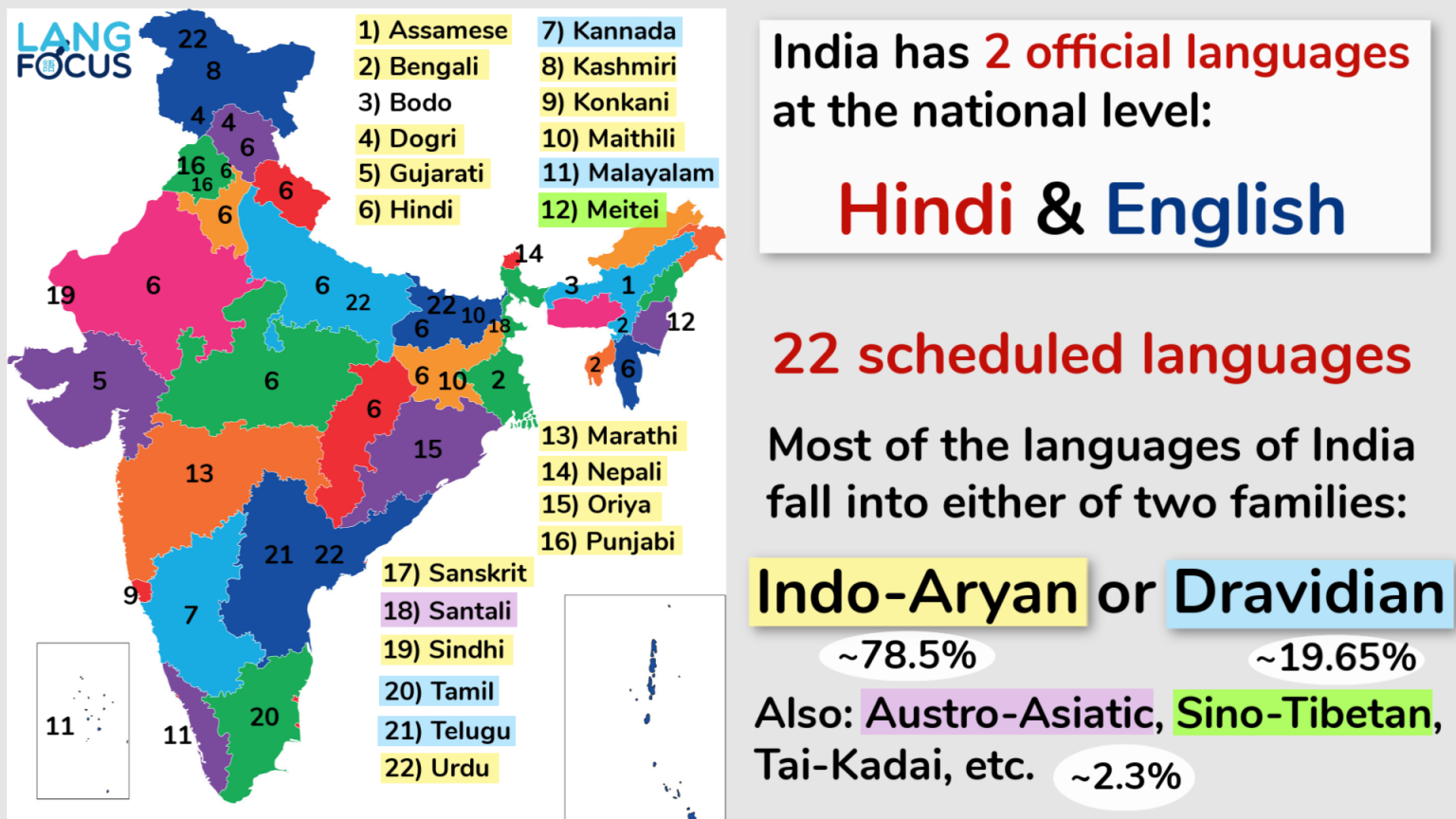
India is a linguistically diverse country, with over 122 major languages and 1500 dialects spoken. These languages belong to four major language families: Indo-Aryan, Dravidian, Austroasiatic, and Sino-Tibetan.
The major Indo-Aryan languages include Hindi, Bengali, Marathi, Gujarati, and Punjabi. These languages are spoken in the northern and central regions of India and are the most widely spoken languages in the country.
Official Languages of India
India has two official languages: Hindi and English. Hindi is the most widely spoken language in India, with over 44% of the population speaking it as their first language. English is the second official language and is used extensively in government, education, and media.
The adoption of Hindi and English as official languages has been a subject of debate and controversy. Hindi is seen as the national language by many, while English is seen as a more global language that can facilitate communication with the rest of the world.
Preservation and Promotion of Linguistic Diversity
The Indian government has made efforts to preserve and promote the linguistic diversity of the country. The Constitution of India recognizes 22 languages as official languages, and the government provides support for the development and preservation of these languages.
There are also a number of language policies and educational programs aimed at promoting linguistic diversity. These policies include the National Policy on Education (1986), which promotes the use of mother tongue in education, and the Official Languages Act (1963), which provides for the use of Hindi and English in official communication.
Challenges in Managing Linguistic Diversity
Managing linguistic diversity in India presents a number of challenges. Language barriers can make it difficult for people from different linguistic backgrounds to communicate with each other. This can lead to misunderstandings, conflict, and social division.
Another challenge is the preservation of endangered languages. Many of the smaller languages spoken in India are facing extinction due to the dominance of the larger languages. The government has taken steps to address this issue, but more needs to be done to ensure the survival of these languages.
Hindi: The Most Widely Spoken Language
Hindi is the most widely spoken language in India, with over 550 million native speakers. It is the official language of the Indian government and is used in administration, education, and the media. Hindi is also one of the two official languages of the state of Uttar Pradesh, the most populous state in India.The geographical distribution of Hindi speakers is concentrated in the northern and central regions of India, including the states of Uttar Pradesh, Bihar, Madhya Pradesh, Rajasthan, and Haryana.
Hindi is also spoken by significant populations in the western states of Gujarat and Maharashtra, and in the eastern states of West Bengal and Odisha.Hindi has a rich history and has evolved over centuries. It is derived from Sanskrit, the ancient language of India, and has been influenced by Persian, Arabic, and Turkish.
Hindi has several dialects and variations, which are spoken in different regions of India.Hindi plays a significant role in Indian cinema, literature, and music. It is the primary language of Bollywood, the Hindi film industry, and is used in numerous popular songs and novels.
Hindi is also the language of instruction in many schools and universities in India.As a lingua franca, Hindi serves as a means of communication between people from different linguistic backgrounds in India. It is used in government offices, businesses, and educational institutions.
Hindi has also gained importance as a global language, with significant populations of Hindi speakers in other countries, including the United States, the United Kingdom, and Canada.In the 21st century, Hindi faces several challenges and opportunities. One challenge is the growing influence of English in India, which is seen as a language of global communication and economic opportunity.
However, Hindi remains the language of the majority of Indians and continues to play a vital role in Indian society.
English: The Associate Official Language
English is one of the two official languages of India, along with Hindi. It is an associate official language, which means that it is used in official communication and documents alongside Hindi. English has a long history in India, dating back to the British colonial period.
The adoption of English as an associate official language was influenced by several historical factors. First, English was the language of the British administration and was used in education, government, and business. Second, after independence, English was retained as an official language to maintain continuity and facilitate communication between different regions of India.
Third, English is a global language and its use in India helps the country to connect with the rest of the world.
Usage of English in Government
English is used in all levels of government in India, from the central government to the state and local governments. It is the language of official communication, legislation, and court proceedings. In addition, English is used in the education system, with many schools and universities offering instruction in English.
Usage of English in Business
English is also widely used in business in India. Many large corporations and multinational companies use English as their official language. In addition, English is often used in international business transactions.
Regional Languages of India

India is a linguistically diverse country with over 122 major languages and 1599 other languages. The regional languages of India are spoken by a significant portion of the population and play a vital role in the cultural and social fabric of the country.
These languages have a rich history and have been influenced by various factors, including geography, religion, and trade.
The following table lists some of the major regional languages of India, along with their geographical distribution and approximate number of speakers:
| Language | Geographical Distribution | Number of Speakers |
|---|---|---|
| Assamese | Assam | 15 million |
| Bengali | West Bengal, Tripura, Assam | 90 million |
| Gujarati | Gujarat, Dadra and Nagar Haveli and Daman and Diu | 55 million |
| Kannada | Karnataka | 45 million |
| Kashmiri | Jammu and Kashmir | 7 million |
| Konkani | Goa, Maharashtra, Karnataka | 2.5 million |
| Malayalam | Kerala, Lakshadweep | 38 million |
| Marathi | Maharashtra, Goa | 83 million |
| Odia | Odisha | 38 million |
| Punjabi | Punjab, Haryana, Himachal Pradesh, Jammu and Kashmir | 30 million |
| Rajasthani | Rajasthan | 50 million |
| Tamil | Tamil Nadu, Puducherry | 77 million |
| Telugu | Telangana, Andhra Pradesh | 84 million |
| Urdu | Uttar Pradesh, Bihar, Jammu and Kashmir, Telangana | 50 million |
These regional languages have a rich cultural and historical significance. They are used in literature, music, theater, and other forms of cultural expression. They also play a vital role in education, administration, and the media. The preservation and promotion of these languages are essential for maintaining the cultural diversity and heritage of India.
Classical Languages of India

Classical languages of India hold a significant position in the nation’s cultural and linguistic heritage. Recognized for their antiquity, literary richness, and grammatical complexity, these languages have played a pivotal role in shaping India’s intellectual, religious, and cultural landscape.
The classical languages of India are Sanskrit, Tamil, Kannada, Telugu, Malayalam, and Odia. Each of these languages possesses a distinct history, literary tradition, and cultural significance.
Sanskrit
Sanskrit, the oldest among the classical languages, is the liturgical language of Hinduism, Buddhism, and Jainism. It has a rich literary tradition dating back to the Vedic period (1500-500 BCE). Sanskrit literature encompasses religious texts, epics, dramas, poetry, and scientific treatises.
Tamil
Tamil, spoken primarily in southern India, is one of the oldest Dravidian languages. Its literary tradition dates back to the Sangam period (300 BCE – 300 CE). Tamil literature includes epics, poetry, drama, and philosophical works.
Kannada
Kannada, spoken in the southwestern state of Karnataka, has a literary tradition dating back to the 9th century CE. Kannada literature includes epics, poetry, drama, and religious texts.
Telugu
Telugu, spoken in the southeastern state of Andhra Pradesh, has a literary tradition dating back to the 11th century CE. Telugu literature includes epics, poetry, drama, and religious texts.
Malayalam
Malayalam, spoken in the southwestern state of Kerala, has a literary tradition dating back to the 13th century CE. Malayalam literature includes epics, poetry, drama, and religious texts.
Odia
Odia, spoken in the eastern state of Odisha, has a literary tradition dating back to the 15th century CE. Odia literature includes epics, poetry, drama, and religious texts.
Preservation and Promotion of Classical Languages
The preservation and promotion of classical languages in India is a matter of national importance. The government of India has established various organizations and initiatives to support these languages.
- Central Institute of Classical Tamil
- Central Institute of Kannada Studies
- Central Institute of Telugu Studies
- Central Institute of Malayalam Studies
- Central Institute of Odia Studies
These organizations work to promote research, teaching, and publication in classical languages. They also organize conferences, workshops, and other events to raise awareness about these languages.
Importance of Preserving Classical Languages
Preserving classical languages is essential for several reasons. These languages contain a wealth of knowledge and wisdom that can inform and inspire future generations. They also provide a link to India’s past and help to preserve the nation’s cultural heritage.
Language Policy in India
The Indian government’s language policy is based on the three-language formula, which was adopted in 1968. This formula aims to promote multilingualism in India, where there are 22 officially recognized languages and over 1,500 dialects.
The three-language formula requires students to study three languages: Hindi, English, and a regional language. Hindi is the official language of the Union of India, while English is an associate official language. Regional languages are the official languages of the respective states and territories of India.
Rationale behind the Three-Language Formula
The three-language formula was adopted to address several concerns:
- National Unity:Promoting the study of Hindi, the national language, was seen as a way to foster a sense of unity among the diverse population of India.
- International Communication:English, being a global language, was included to facilitate communication with the international community.
- Regional Identity:The inclusion of regional languages aimed to preserve and promote the linguistic diversity of India.
Challenges and Successes of Language Policy Implementation
The implementation of the three-language formula has faced several challenges:
- Regional Resistance:Some states have resisted the imposition of Hindi as the national language, leading to tensions and conflicts.
- Inadequate Infrastructure:Many schools lack qualified teachers and resources to effectively teach all three languages.
- English Dominance:In urban areas, English has become the dominant language of education and communication, overshadowing regional languages.
Despite these challenges, the three-language formula has also had some successes:
- Multilingual Population:The formula has contributed to the creation of a multilingual population in India, with many people being able to speak multiple languages.
- Cultural Preservation:The inclusion of regional languages has helped to preserve and promote the linguistic and cultural diversity of India.
- Economic Benefits:Proficiency in English has provided economic opportunities for Indians in the globalized economy.
Influence of Foreign Languages on Indian Languages
The diverse linguistic landscape of India has been significantly influenced by foreign languages throughout history. The adoption and integration of loanwords, grammatical structures, and even entire alphabets have shaped the evolution of Indian languages.
Loanwords and their Impact
Indian languages have borrowed extensively from various foreign languages, including:
English
“computer,” “television,” “science”
Persian
“khwab” (dream), “ishq” (love), “bazaar” (market)
Arabic
“kitab” (book), “madrasa” (school), “adab” (etiquette)These loanwords have enriched Indian languages, providing new vocabulary to express modern concepts and ideas.
Globalization and Technology
Globalization and technological advancements have accelerated language change. The widespread use of English in international communication, education, and entertainment has led to the adoption of numerous English words into Indian languages. Additionally, social media and the internet have facilitated the exchange of ideas and languages across borders.
Socio-Cultural Factors
The adoption of foreign words is influenced by socio-cultural factors such as:
Prestige
Languages associated with power and status tend to have a greater influence on other languages.
Education
Formal education systems often promote the use of certain languages, which can lead to the adoption of foreign words.
The question of what language does India speak is complex, as the country is home to a diverse range of linguistic communities. While Hindi is the official language of the Indian government, it is spoken by only about 44% of the population.
Other major languages include Bengali, Telugu, Marathi, and Tamil. For a more comprehensive understanding of the linguistic landscape of India, refer to what is the language for india.
Migration
The movement of people between different linguistic regions can facilitate the transfer of words and phrases.
Preservation and Evolution
The influence of foreign languages on Indian languages has both positive and negative implications. On one hand, it enriches vocabulary and facilitates communication in a globalized world. On the other hand, it can potentially lead to the loss of indigenous words and expressions.
However, Indian languages have demonstrated resilience and adaptability, incorporating foreign elements while retaining their distinct identities.
Comparative Analysis
The influence of foreign languages on Indian languages varies across regions and languages. Some languages, such as Hindi and Urdu, have been heavily influenced by Persian and Arabic, while others, like Tamil and Malayalam, have preserved their Dravidian roots more strongly.
Code-Switching and Code-Mixing
Foreign language influence has also led to the widespread use of code-switching and code-mixing in Indian languages. This phenomenon involves the alternation between two or more languages within a single conversation. It reflects the multilingual nature of Indian society and the increasing interconnectedness of the world.
Language Policy and Education
The influence of foreign languages has implications for language policy and education in India. The government recognizes the importance of preserving indigenous languages while promoting the use of English as a lingua franca. Educational institutions play a crucial role in balancing these goals and ensuring the vitality of both Indian and foreign languages.
Language and Identity in India: What Language Does India Speak
In India, language plays a crucial role in shaping cultural and regional identities. The connection between language and identity is deeply ingrained in the country’s history, culture, and society. The diverse linguistic landscape of India reflects the rich tapestry of its cultural heritage and the enduring influence of regional traditions.
The Role of Language in Shaping Cultural and Regional Identities
Language is a fundamental aspect of cultural identity. It embodies the shared values, beliefs, and experiences of a community. In India, the numerous languages spoken across the country have shaped distinct cultural and regional identities. Each language carries its unique vocabulary, grammar, and literary traditions that reflect the specific worldview and cultural ethos of its speakers.
For instance, the Tamil language in southern India is closely associated with the ancient Tamil civilization and its rich literary heritage. The language has preserved a vast body of classical literature, including the Sangam poetry, which provides invaluable insights into the social, cultural, and religious life of the Tamils.
Similarly, the Hindi language in northern India has played a significant role in shaping the cultural identity of the Hindi-speaking regions. The language has been influenced by various historical and cultural factors, including the influence of Sanskrit, Persian, and Arabic.
Hindi literature has produced some of the most renowned works in Indian literature, such as the Ramayana and the Mahabharata.
Language-Based Movements and Their Impact on Society
The connection between language and identity has often led to language-based movements in India. These movements have aimed to promote and protect the linguistic rights of specific language groups and have had a significant impact on society.
One notable example is the Telugu language movement in the 1950s and 1960s. The movement sought to establish Telugu as the official language of the Andhra Pradesh state. The movement gained widespread support and eventually led to the formation of the state of Andhra Pradesh in 1956, with Telugu as its official language.
Language-based movements have also played a role in shaping the political landscape of India. The formation of linguistic states in the post-independence period was largely influenced by the demand for recognition of linguistic identities.
The Relationship Between Language, Power, and Social Stratification
Language is closely intertwined with power and social stratification in India. The dominant languages, such as Hindi and English, enjoy greater prestige and access to resources, while minority languages may face marginalization and discrimination.
The use of English as the associate official language of India has created a linguistic divide in society. English proficiency is often seen as a marker of social status and economic opportunity, leading to unequal access to education, employment, and other societal benefits.
The dominance of certain languages can also lead to the suppression of minority languages and their associated cultures. This can result in the loss of linguistic diversity and the erosion of cultural heritage.
The Impact of Globalization and Migration on Language and Identity in India
Globalization and migration have had a significant impact on language and identity in India. The increased interconnectedness of the world has led to the spread of global languages, such as English, and the emergence of new linguistic communities.
Migration within India and to other countries has also contributed to the linguistic diversity of urban centers. Migrant communities often maintain their native languages and cultural practices, creating linguistic enclaves within larger metropolitan areas.
While globalization and migration can promote linguistic diversity, they can also lead to the erosion of local languages and cultural traditions. The dominance of global languages in media, education, and the workplace can pose a threat to the vitality of minority languages.
India is a multilingual country with 22 official languages. Hindi is the most widely spoken language, followed by Bengali, Telugu, Marathi, Tamil, and Gujarati. If you’re wondering how to change the language on Disney Plus, you can follow these steps: how to change language on disney plus.
Once you’ve changed the language, you can enjoy your favorite Disney Plus shows and movies in your preferred language. It’s important to note that not all Disney Plus content is available in all languages.
The Challenges and Opportunities of Language Diversity in India
The linguistic diversity of India presents both challenges and opportunities. On the one hand, it is a source of cultural richness and a reflection of the country’s historical and cultural heritage. On the other hand, it can also lead to linguistic fragmentation and communication barriers.
One of the challenges is the promotion of linguistic harmony and national unity amidst the diverse linguistic landscape. The Indian government has adopted a multilingual policy that recognizes the importance of regional languages and promotes their development.
The opportunities presented by linguistic diversity include the potential for cultural exchange, the preservation of cultural heritage, and the promotion of inclusive education. By fostering linguistic diversity, India can harness the richness of its linguistic heritage and create a more equitable and inclusive society.
Recommendations for Promoting Linguistic Harmony and Fostering a Sense of National Unity
To promote linguistic harmony and foster a sense of national unity while preserving cultural and linguistic diversity, several recommendations can be considered:
- Promote multilingual education:Encourage the teaching and learning of multiple languages at all levels of education to foster linguistic competence and understanding.
- Support minority languages:Provide resources and support for the preservation and development of minority languages to ensure their vitality and cultural significance.
- Encourage cultural exchange:Promote cultural exchange programs and initiatives that bring together people from different linguistic backgrounds to foster understanding and appreciation.
- Foster linguistic tolerance:Promote awareness and respect for linguistic diversity and encourage dialogue and understanding among speakers of different languages.
- Create inclusive policies:Develop policies that recognize and accommodate linguistic diversity in all aspects of public life, including education, employment, and media.
By implementing these recommendations, India can harness the power of its linguistic diversity to create a more harmonious and inclusive society while preserving its rich cultural heritage.
Language and Education in India

Language plays a crucial role in the Indian education system, serving as both a medium of instruction and a subject of study. However, the multilingual nature of India presents challenges in providing education in multiple languages, impacting access to education and educational outcomes.
Challenges in Providing Education in Multiple Languages
India’s linguistic diversity poses challenges for the education system, including:
- Limited availability of textbooks and teaching materials in all languages.
- Shortage of qualified teachers who are proficient in multiple languages.
- Difficulty in assessing students’ understanding when exams are conducted in a language other than their mother tongue.
Impact on Access to Education
Language barriers can limit access to education for students from linguistic minorities. They may face difficulties in understanding the curriculum, participating in class discussions, and accessing educational resources.
Impact on Educational Outcomes
Language proficiency affects educational outcomes. Students who receive instruction in their mother tongue tend to perform better academically than those who are taught in a language they do not understand well.
Language and Technology in India
The advent of technology has significantly impacted language use in India. The widespread adoption of smartphones, the internet, and social media platforms has transformed the way Indians communicate, access information, and consume entertainment.
Role of Social Media and the Internet in Language Dissemination
Social media and the internet have played a pivotal role in disseminating languages across India. These platforms have enabled individuals to connect with others who share their linguistic heritage, regardless of geographic location. They have also facilitated the creation and sharing of content in various Indian languages, making them more accessible to a wider audience.
Development of Language-Specific Technologies, What language does india speak
The technological revolution has led to the development of language-specific technologies that have further enhanced the use and preservation of Indian languages. These technologies include:
- Language learning apps that make it easier for people to learn new Indian languages.
- Speech recognition and translation tools that facilitate communication across different linguistic groups.
- Digital dictionaries and corpora that provide comprehensive resources for Indian language research and education.
These technologies have empowered Indian languages and made them more accessible to a global audience.
Language and the Media in India
Language plays a crucial role in the Indian media landscape, shaping media consumption, public discourse, and the coverage of social and political issues. The use of multiple languages in newspapers, television, and radio reflects the linguistic diversity of the country.
This essay explores the relationship between language and media in India, considering its historical, cultural, and political dimensions.
Use of Multiple Languages in Indian Media
India’s media landscape is characterized by the use of multiple languages. Newspapers, television channels, and radio stations cater to diverse linguistic audiences, ensuring accessibility and inclusivity. Regional languages such as Hindi, Tamil, Telugu, Bengali, and Marathi have a significant presence in print and electronic media.
English, the associate official language, also plays a vital role, particularly in national and international news coverage.
Impact of Language on Media Consumption and Public Discourse
The use of multiple languages in the media has a significant impact on media consumption and public discourse. Individuals tend to consume media content in their native language, leading to the formation of linguistic communities within the media landscape. This can influence the flow of information and the shaping of public opinion, as different linguistic groups may have varying perspectives and interpretations of events.
Language and Media Coverage of Social and Political Issues
Language also plays a role in shaping media coverage of social and political issues in India. The use of certain words, phrases, and narratives can influence the way events are perceived and understood by the public. For example, the portrayal of marginalized communities or minority groups in the media can be influenced by the language used to describe them.
Challenges and Opportunities for Media Outlets
Media outlets in India face challenges and opportunities in catering to diverse linguistic audiences. The need to produce content in multiple languages can be resource-intensive, and reaching audiences across linguistic boundaries can be difficult. However, the use of digital platforms and social media provides opportunities for media outlets to expand their reach and engage with audiences in their preferred languages.
Language and Literature in India
India boasts a rich literary heritage, spanning centuries and encompassing diverse languages. From ancient Sanskrit epics to modern-day regional novels, Indian literature has left an indelible mark on the country’s culture and identity.
The major literary genres in India include poetry, drama, prose, and epic. Poetry, in particular, has a long and distinguished history, with renowned poets like Kalidasa and Rabindranath Tagore leaving behind a legacy of timeless works. Drama, too, has flourished in India, with classical plays like Bhasa’s “The Clay Cart” and Kalidasa’s “Shakuntala” showcasing the depth and sophistication of Indian theater.
Role of Language in Shaping Literary Expression
The choice of language plays a crucial role in shaping literary expression. While Sanskrit was the dominant literary language in ancient India, regional languages like Tamil, Telugu, Kannada, and Bengali have produced a vast body of literature over the centuries.
Each language brings its unique nuances, idioms, and cultural context to literary works, resulting in a diverse and vibrant literary landscape.
– Identify emerging trends in language use in India, considering both spoken and written forms of communication.
The linguistic landscape of India is undergoing significant transformations, marked by the emergence of new trends in language use. These trends are influenced by various factors, including urbanization, migration, technological advancements, and globalization.
One notable trend is the increasing dominance of English in both spoken and written communication. English, which serves as the associate official language of India, is gaining prominence in urban areas, educational institutions, and corporate sectors. This trend is driven by the need for a common language of communication in a multilingual society and the perceived advantages of English in globalized contexts.
Another trend is the rise of Hinglish, a hybrid language that blends Hindi and English. Hinglish has become increasingly popular in informal communication, particularly among urban youth. It reflects the growing influence of English on Hindi and the need for a language that can accommodate both formal and informal contexts.
Furthermore, the use of regional languages is also undergoing changes. While regional languages remain strong in rural areas and within specific communities, they are facing competition from English and Hindi in urban settings. This trend is particularly evident in the younger generations, who are often more proficient in English and Hindi than their regional languages.
The rise of new media and social media platforms has also had a significant impact on language use in India. These platforms have facilitated the spread of new forms of communication, such as instant messaging, social media posts, and online forums.
These platforms have also contributed to the growth of Hinglish and other hybrid languages, as users often mix multiple languages in their online interactions.
General Inquiries
What is the official language of India?
Hindi and English are the two official languages of India.
How many languages are spoken in India?
There are over 122 major languages and 1500 dialects spoken in India.
What is the most widely spoken language in India?
Hindi is the most widely spoken language in India.
What are the classical languages of India?
Sanskrit, Tamil, Telugu, Kannada, Malayalam, Odia, and Pali are the classical languages of India.
