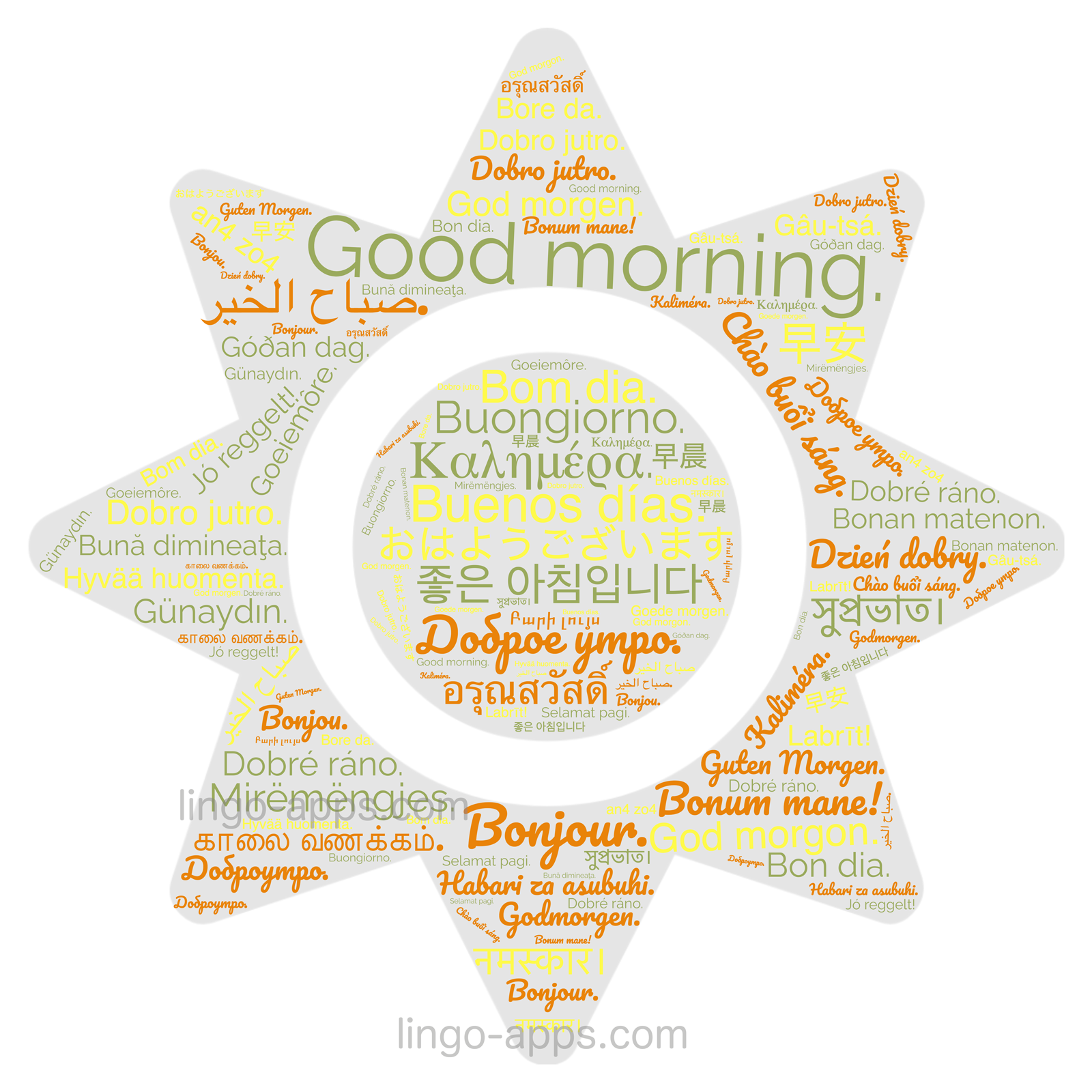
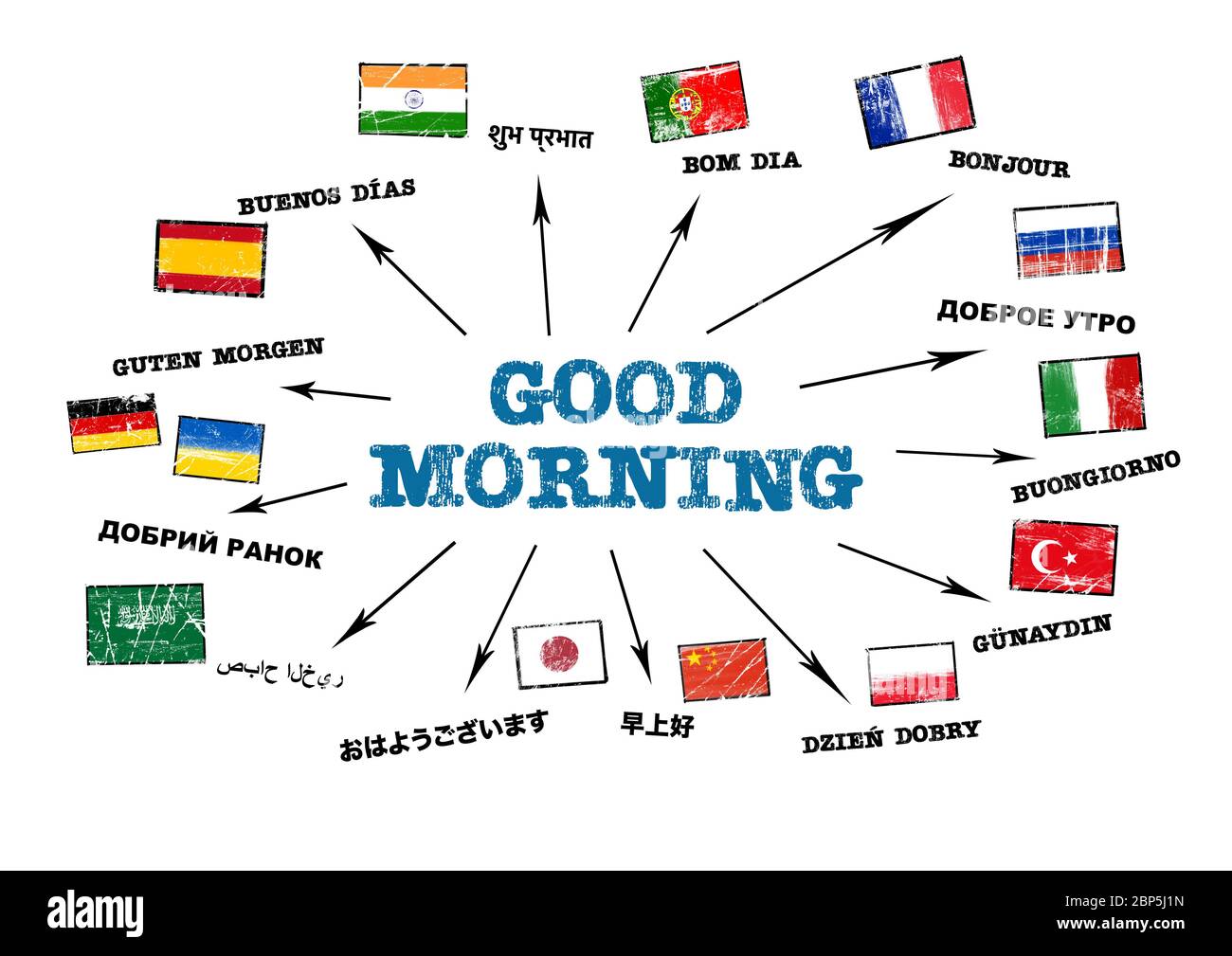
How to say good morning in different languages – In the tapestry of human interactions, greetings hold a special place, serving as the first threads that connect us. Embark on a linguistic adventure as we delve into the diverse ways people around the world express the simple yet profound phrase, “Good morning.” From the familiar to the exotic, each greeting unveils a glimpse into the cultural fabric of its speakers.
As we traverse the globe, we’ll encounter the subtle variations in how people bid each other a bright start to the day. Whether it’s the formal “Guten Morgen” in German or the melodious “Buongiorno” in Italian, each greeting carries a unique charm and significance.
Languages of the World

Languages are an integral part of human communication, expressing our thoughts, ideas, and emotions. The world is a tapestry of diverse languages, each with its unique history, structure, and cultural significance.
The exact number of languages spoken globally is challenging to determine, as languages evolve and new dialects emerge. However, estimates suggest there are between 6,000 to 7,000 distinct languages spoken around the globe.
Language Families
Languages can be categorized into language families based on shared linguistic characteristics and common ancestry. Some of the major language families include:
- Indo-European:Includes languages like English, Spanish, French, Hindi, and Russian.
- Sino-Tibetan:Includes languages like Mandarin, Cantonese, Tibetan, and Burmese.
- Austronesian:Includes languages like Indonesian, Malay, Tagalog, and Hawaiian.
- Afro-Asiatic:Includes languages like Arabic, Hebrew, Berber, and Somali.
- Niger-Congo:Includes languages like Swahili, Yoruba, Zulu, and Wolof.
Languages by Number of Native Speakers
The number of native speakers for a language can vary significantly. Some of the most widely spoken languages include:
| Language | Native Speakers |
|---|---|
| Mandarin Chinese | 1.121 billion |
| Spanish | 460 million |
| English | 373 million |
| Hindi | 341 million |
| Arabic | 319 million |
Greetings in Different Cultures

Greetings are an essential part of human communication, and they vary greatly from culture to culture. The way we greet each other can convey a wealth of information about our social status, our age, our gender, and our relationship to the person we are greeting.In some cultures, such as the United States, it is customary to shake hands when meeting someone for the first time.
In other cultures, such as Japan, it is more common to bow. In still other cultures, such as Thailand, it is considered polite to wai, which involves placing the palms of the hands together in front of the chest and bowing the head.The cultural significance of greetings cannot be overstated.
Greetings are a way of showing respect for others, and they can also help to build relationships. When we greet someone in a way that is appropriate for their culture, we are showing them that we respect their customs and that we are interested in getting to know them.There are many different factors that can influence the way we greet each other.
These factors include social hierarchy, age, and gender.
Social Hierarchy
In many cultures, there is a clear social hierarchy, and the way we greet someone is often determined by their position in the hierarchy. For example, in Japan, it is considered polite to bow to someone who is older or who has a higher social status.
Age
In some cultures, the way we greet someone is also influenced by their age. For example, in many Asian cultures, it is considered polite to greet an older person with a bow.
Gender
In some cultures, the way we greet someone is also influenced by their gender. For example, in some cultures, it is considered more polite for a man to shake a woman’s hand than for a woman to shake a man’s hand.It is important to be aware of the cultural significance of greetings when traveling to a new country.
By understanding the local customs, you can avoid making any faux pas and ensure that you make a good impression.
Formal and Informal Greetings
Formal greetings are used in professional and formal settings, such as business meetings, job interviews, and written correspondence. They are typically more polite and respectful than informal greetings.Informal greetings are used in casual settings, such as among friends, family, and acquaintances.
They are typically more relaxed and friendly than formal greetings.The appropriate usage of formal and informal greetings depends on the context. In general, it is best to use formal greetings in professional and formal settings, and informal greetings in casual settings.
Examples of Formal and Informal Greetings
Here are some examples of formal and informal greetings in various languages: Formal Greetings* English: “Good morning”
Spanish
“Buenos días”
French
“Bonjour”
German
“Guten Morgen”
Chinese
“你好” (nǐ hǎo) Informal Greetings* English: “Hi”
Spanish
“Hola”
French
“Salut”
German
“Hallo”
Chinese
“嗨” (hāi)
When to Use Formal and Informal Greetings
Formal greetings should be used in the following situations:* When meeting someone for the first time
- When addressing someone in a position of authority
- When writing a formal letter or email
- When making a presentation or speech
Informal greetings should be used in the following situations:* When greeting friends or family
- When speaking to someone you know well
- When writing a casual email or text message
- When having a conversation in a casual setting
It is important to be aware of the appropriate usage of formal and informal greetings in different contexts. Using the wrong type of greeting can make you appear unprofessional or disrespectful.
Time-Specific Greetings

Greetings often vary depending on the time of day, reflecting the cultural significance of specific times. Understanding these variations enhances cross-cultural communication and demonstrates respect for local customs.
Cultural Significance
Time-specific greetings acknowledge the changing nature of the day and the activities associated with different times. For example, morning greetings may express well wishes for a productive day, while evening greetings may convey hopes for a restful night.
Learning how to greet someone in different languages is a great way to immerse yourself in new cultures. From “bonjour” in French to “buongiorno” in Italian, each language offers its unique way to say hello. Sign language is no exception, with different types of sign language existing around the world.
How many types of sign language are there ? It depends on the country and region, but there are many different sign languages, each with its own grammar, vocabulary, and culture. Just as saying “good morning” varies across spoken languages, so too does the sign for “good morning” vary across different sign languages.
Time-Specific Greetings in Multiple Languages
| Language | Morning | Afternoon | Evening |
|---|---|---|---|
| English | Good morning | Good afternoon | Good evening |
| Spanish | Buenos días | Buenas tardes | Buenas noches |
| French | Bonjour | Bon après-midi | Bonsoir |
| German | Guten Morgen | Guten Tag | Guten Abend |
| Mandarin Chinese | 早上好 (zǎoshang hǎo) | 下午好 (xiàwǔ hǎo) | 晚上好 (wǎnshàng hǎo) |
Incorporation in Dialogue
“Good morning, Mrs. Jones,” said Emily as she entered the office. “I hope you had a restful weekend.”
“Good morning, Emily,” replied Mrs. Jones. “Thank you. I did indeed. How was yours?”
This dialogue demonstrates the use of time-specific greetings in a professional setting, acknowledging the start of the workday and expressing well wishes.
– Explore the regional variations in greetings within a single language.
Greetings vary not only across different languages but also within a single language, influenced by regional factors such as culture, history, and geography.
For instance, in English, the common greeting “Hello” has several regional variations. In the United States, “Howdy” is commonly used in the South and Midwest, while “G’day” is popular in Australia and New Zealand.
These regional variations often reflect cultural differences. For example, the Spanish greeting “Hola” is more formal than the Mexican greeting “Oye,” which is more casual and friendly.
Historical events can also influence regional variations in greetings. In the United Kingdom, the greeting “Good morning” is typically used until noon, while in the United States, it is generally used only until 10 or 11 am. This difference is attributed to the fact that the United States adopted a more informal and egalitarian culture than the United Kingdom.
Geographical isolation can also lead to regional variations in greetings. For example, the people of the Canary Islands, which are located off the coast of Africa, have developed their unique greeting, “Que tal,” which is not commonly used in mainland Spain.
Regional variations in greetings can impact communication and social interactions. For example, a person from the United States who greets someone from the United Kingdom with “Howdy” may be perceived as being too informal or even rude.
To avoid misunderstandings or失礼, travelers should be aware of the regional variations in greetings and use the appropriate greeting for the situation.
Non-Verbal Greetings: How To Say Good Morning In Different Languages

Non-verbal cues play a significant role in greetings, conveying messages beyond words. These cues include gestures, facial expressions, and body language, and they vary significantly across cultures.
Gestures, such as handshakes, bows, and embraces, are common forms of non-verbal greetings. The strength and duration of a handshake, for example, can indicate the level of respect and familiarity between individuals.
Facial Expressions
Facial expressions are another important non-verbal cue in greetings. A smile is universally recognized as a sign of friendliness and welcome, while a frown or furrowed brow can convey disapproval or discomfort.
Body Language
Body language also plays a role in greetings. Standing up straight, making eye contact, and maintaining an open posture can indicate confidence and respect. Conversely, slouching, avoiding eye contact, or crossing one’s arms can convey disinterest or hostility.
The effectiveness of greetings can be significantly impacted by non-verbal cues. A warm smile and a firm handshake can create a positive first impression, while inappropriate gestures or body language can lead to miscommunication or offense.
It is important to be aware of the cultural differences in non-verbal greetings to avoid misunderstandings. For example, in some cultures, it is considered rude to make direct eye contact with someone of a higher social status, while in other cultures, it is seen as a sign of respect.
By using non-verbal cues appropriately, we can enhance the effectiveness of our greetings and build stronger relationships across cultures.
Unique and Unusual Greetings
Greetings around the world are diverse and often reflect the unique cultural practices and beliefs of different regions. Some greetings are particularly unusual or unique, standing out from the more common forms of salutation. These greetings often carry deep cultural significance and provide insights into the values and traditions of the communities that use them.
Cultural Significance and Development
Unique greetings often emerge from specific cultural contexts and serve various purposes. They may be used to express respect, affection, or even challenge. The reasons behind their development can be complex and may include historical events, religious beliefs, or social customs.
For instance, the Maori greeting of “hongi,” which involves pressing noses together, is a sign of respect and connection.
Examples of Unique Greetings
Various cultures have developed their own unique greetings. Here are a few examples:
Eskimo Kiss (Inuit)
Rubbing noses together as a sign of affection and welcome.
Maori Hongi (New Zealand)
Pressing noses and foreheads together as a sign of respect and unity.
Thai Wai (Thailand)
Bringing palms together in a prayer-like gesture to show respect and greeting.
Tibetan Tongue Greeting (Tibet)
Sticking out the tongue as a sign of respect and greeting.
Burmese Htamein (Myanmar)
Applying thanaka paste on the face as a greeting and as a symbol of beauty and respect.
Evolution and Cultural Influences
Unique greetings have evolved over time, influenced by cultural exchanges and globalization. Some greetings have become more widespread, while others remain confined to specific regions. Cultural influences have played a significant role in shaping these greetings, as communities adopt or adapt practices from other cultures.
Etiquette and Protocol
Unique greetings often come with specific etiquette and protocol. It is essential to be respectful of local customs and to observe the appropriate manner of greeting. For instance, in some cultures, it is considered rude to make eye contact during a greeting, while in others, it is a sign of respect.
Cross-Cultural Communication and Diplomacy
Understanding unique greetings can be valuable in cross-cultural communication and diplomacy. By being aware of the cultural significance and etiquette associated with different greetings, individuals can avoid misunderstandings and build stronger connections with people from diverse backgrounds.
– Analyze the use of greetings in literature and media, paying particular attention to how they vary across different genres, time periods, and cultures.
Greetings are an essential part of human interaction, and they can vary significantly across different genres, time periods, and cultures. In literature and media, greetings can serve a variety of purposes, from establishing character relationships to foreshadowing events. They can also be used to convey cultural context and narrative progression.
In the novel The Great Gatsby, for example, the way that characters greet each other reveals a great deal about their relationships. The narrator, Nick Carraway, is often greeted with warmth and friendliness by Gatsby, but with coldness and suspicion by Tom Buchanan.
Greeting people in different languages is a fascinating aspect of cultural exchange. From the cheerful “Buongiorno” in Italian to the warm “Bonjour” in French, each language has its unique way of conveying the message of “good morning.” Similarly, in Spanish, the welcoming phrase “Bienvenido” or “Bienvenida” expresses a sense of hospitality and friendliness.
For a more comprehensive understanding of how to say “welcome” in Spanish, visit this informative resource: how to say welcome in spanish language. Returning to the topic of greetings, the diversity of languages offers a glimpse into the rich tapestry of human communication.
This contrast in greetings helps to establish the different relationships that these characters have with Nick.
In the film The Godfather, the way that characters greet each other is often used to foreshadow events. For example, when Michael Corleone is greeted by his father with a kiss on the cheek, it is a sign that Michael is being groomed to take over the family business.
This greeting foreshadows the events that will unfold later in the film, as Michael becomes more and more involved in the Corleone family’s criminal activities.
Greetings can also be used to convey cultural context. In the novel The Joy Luck Club, the way that Chinese immigrants greet each other reveals a great deal about their culture. For example, the characters often greet each other with a bow or a handshake, which are both traditional Chinese gestures of respect.
This use of greetings helps to establish the cultural context of the novel and to create a sense of authenticity.
Greetings in Business and Diplomacy

Greetings play a crucial role in establishing professional relationships and fostering positive interactions in business and diplomatic settings. They serve as a means of acknowledging others, showing respect, and creating a welcoming atmosphere. Understanding the cultural sensitivities and etiquette surrounding greetings is essential for effective communication and successful outcomes.
Appropriate Greetings in Different Professional Contexts
In business settings, the choice of greeting depends on factors such as the industry, company culture, and level of formality. In general, a firm handshake, direct eye contact, and a warm smile are considered appropriate. In more formal contexts, a verbal greeting such as “Good morning, Mr./Ms.
[Name]” is preferred. In diplomatic settings, greetings are often more elaborate and may involve bowing, handshakes, and exchanging business cards. It is important to be aware of the protocol and customs of the country or organization you are interacting with.
Cultural Sensitivities and Etiquette
Cultural sensitivities should be considered when greeting people from different backgrounds. In some cultures, it is customary to bow or nod as a sign of respect. In others, a handshake is the norm. It is important to be observant and respectful of local customs.
In some cultures, it is considered失礼 (失礼) to make direct eye contact with someone of higher status. In others, it is seen as a sign of sincerity. Being aware of these cultural nuances can help avoid misunderstandings and build rapport.
Common Greetings Used in Various Cultures and Languages
Greetings vary widely across cultures and languages. Here are a few common examples:
English
“Good morning”, “Hello”, “How do you do?”
Spanish
“Buenos días”, “Hola”, “¿Cómo está?”
French
“Bonjour”, “Salut”, “Ça va?”
Japanese
“Ohayo gozaimasu”, “Konnichiwa”, “Genki desu ka?”
Chinese
“Zǎo’ān”, “Nǐ hǎo”, “Nǐ hǎo ma?”
Significance of Body Language and Nonverbal Cues
Body language and nonverbal cues play a significant role in greetings. A firm handshake, for example, can convey confidence and professionalism. A warm smile can create a welcoming and friendly atmosphere. It is important to be aware of the nonverbal messages you are sending and to interpret the nonverbal cues of others accurately.
Handling Awkward or Difficult Greeting Situations
Awkward or difficult greeting situations can arise in any context. Here are some tips for handling them:
- Stay calm and composed.
- Apologize if necessary and explain the situation.
- Offer a handshake or other appropriate greeting.
- Try to find common ground and build rapport.
- If the situation persists, seek assistance from a colleague or supervisor.
By understanding the importance of greetings, following appropriate guidelines, and being sensitive to cultural differences, individuals can effectively navigate the complexities of greetings in business and diplomatic settings, fostering positive relationships and achieving successful outcomes.
Technology and Greetings
Technology has had a significant impact on the way people greet each other. In the past, greetings were primarily exchanged in person or through traditional forms of communication such as letters or telephone calls. Today, digital platforms and messaging apps have become increasingly popular channels for greetings, leading to new and innovative ways of connecting with others.
One of the most significant impacts of technology on greetings is the rise of digital platforms. Social media platforms such as Facebook, Twitter, and Instagram have made it possible for people to connect with friends and family members who live far away or who they may not see regularly.
These platforms allow users to share updates about their lives, post photos and videos, and send messages to each other. As a result, people are able to stay connected and greet each other more frequently than they would be able to in person.
Use of Digital Platforms and Messaging Apps for Greetings
Messaging apps such as WhatsApp, Telegram, and Signal have also become popular channels for greetings. These apps allow users to send text messages, voice messages, and videos to each other for free. They are particularly popular among younger generations, who use them to stay connected with friends and family members on a daily basis.
Messaging apps have also made it possible for people to greet each other in new and creative ways, such as by sending GIFs, emojis, and stickers.
Evolution of Greetings in the Digital Age
The evolution of greetings in the digital age has also led to the development of new and innovative ways to connect with others. For example, some companies have developed virtual reality (VR) and augmented reality (AR) applications that allow users to greet each other in virtual environments.
These applications can be used to create immersive and interactive experiences that allow people to feel like they are actually in the same room with each other, even if they are physically separated.
Short Story
One of the most interesting ways that technology has changed the way people greet each other is through the use of artificial intelligence (AI). AI-powered chatbots are now being used by some companies to greet customers and answer their questions.
These chatbots can be programmed to use a variety of greeting styles, depending on the context of the conversation. For example, a chatbot might use a formal greeting when interacting with a customer who is making a purchase, or a more informal greeting when interacting with a customer who is simply browsing a website.
Here is a short story that demonstrates how technology has changed the way people greet each other:
Once upon a time, there was a young woman named Alice who lived in a small town. She was a kind and friendly person, but she was also very shy. She often found it difficult to greet people, especially strangers.
One day, Alice decided to download a new messaging app called “Hello.” The app allowed her to send messages to people who were nearby, even if she didn’t know them. Alice was hesitant at first, but she eventually decided to give it a try.
Alice was surprised to find that she enjoyed using the app. She was able to meet new people and make friends from all over the world. She also found that it was much easier to greet people on the app than it was in person.
She no longer had to worry about making eye contact or saying the right thing. She could simply send a message and wait for the other person to respond.
One day, Alice was using the app when she came across a message from a man named Bob. Bob was from a different country, and he was visiting Alice’s town. Alice was intrigued by Bob’s message, and she decided to send him a reply.
They quickly became friends, and they started chatting every day. After a few weeks, Bob decided to visit Alice in her town. Alice was nervous about meeting Bob in person, but she was also excited. She had never met anyone from another country before.
When Bob arrived in Alice’s town, they met at a coffee shop. Alice was surprised to find that Bob was just as kind and friendly as he seemed online. They talked for hours, and they quickly became close friends. Alice was so glad that she had decided to download the messaging app.
It had changed her life in so many ways. She had met new friends, she had become more confident, and she had learned about different cultures. She was no longer the shy girl she had once been.
Cross-Cultural Communication and Greetings
Greetings are an essential part of any culture, and they can vary significantly from one place to another. When communicating with people from different cultures, it is important to be aware of these differences and to adapt your greeting style accordingly.Cultural awareness and sensitivity are key when greeting others.
This means being aware of the customs and norms of the culture you are interacting with, and respecting those customs. For example, in some cultures it is considered rude to make eye contact with someone you do not know, while in other cultures it is considered impolite to avoid eye contact.There are a number of things you can do to ensure effective cross-cultural communication in greetings.
First, it is important to research the customs of the culture you will be interacting with. This can be done through books, articles, or online resources. Second, it is important to be respectful of the other culture’s customs, even if they are different from your own.
Third, it is important to be patient and understanding. Cross-cultural communication can be challenging, but it is also rewarding.Here are some common greeting customs from different cultures:
- In China, it is customary to bow when greeting someone. The deeper the bow, the more respect you are showing.
- In Japan, it is customary to say “konnichiwa” when greeting someone. The word “konnichiwa” means “good day.”
- In India, it is customary to say “namaste” when greeting someone. The word “namaste” means “I bow to you.”
- In the United States, it is customary to shake hands when greeting someone.
It is important to note that these are just a few examples of common greeting customs from different cultures. There are many other cultures with their own unique greeting customs. When in doubt, it is always best to err on the side of caution and be respectful of the other culture’s customs.Here is a table summarizing key differences in greeting customs across cultures:| Culture | Gesture | Verbal Expression | Physical Contact ||—|—|—|—|| China | Bow | Ni hao | Handshake || Japan | Bow | Konnichiwa | Handshake || India | Namaste | Namaste | Touching feet || United States | Handshake | Hello | Handshake |Here are some “Do’s” and “Don’ts” for greeting people from different cultures: Do’s:
- Do research the customs of the culture you will be interacting with.
- Do be respectful of the other culture’s customs.
- Do be patient and understanding.
- Do err on the side of caution when in doubt.
Don’ts:
- Don’t assume that your own greeting customs are the same as those of other cultures.
- Don’t be disrespectful of the other culture’s customs.
- Don’t be impatient or judgmental.
- Don’t make assumptions about the other person’s culture.
Technology has played a significant role in cross-cultural greetings. Video conferencing and social media have made it possible to communicate with people from all over the world. This has led to a greater awareness of different cultures and their greeting customs.Here are some tips for adapting your own greeting style to different cultural contexts:
- Be aware of the cultural context of the situation.
- Be respectful of the other culture’s customs.
- Be patient and understanding.
- Be willing to learn about new cultures.
Here is a sample dialogue that demonstrates effective cross-cultural communication in greetings: Person A:Hello, my name is John. I’m from the United States. Person B:Ni hao, my name is Li. I’m from China. Person A:It’s nice to meet you, Li.
Person B:It’s nice to meet you too, John.In this dialogue, Person A uses a greeting that is common in the United States, while Person B uses a greeting that is common in China. Both people are respectful of each other’s cultures, and the conversation proceeds smoothly.Cross-cultural communication can be challenging, but it is also rewarding.
By being aware of the customs of different cultures, and by being respectful and understanding, you can build strong relationships with people from all over the world.
The Power of a Good Greeting

A warm and genuine greeting has the power to make a significant impact on our lives. It can brighten our day, make us feel more connected to others, and even help us build stronger relationships.
When we greet someone with a smile and a kind word, we are showing them that we care about them and that we are interested in getting to know them better. This can create a positive atmosphere and make it easier to start a conversation.
In fact, studies have shown that people who are greeted with a smile are more likely to be friendly and cooperative.
Building Relationships
Greetings can also help us build relationships. When we make an effort to greet someone regularly, we are showing them that we value their presence in our lives. This can lead to stronger bonds and more meaningful connections.
For example, a study conducted by the University of California, Berkeley found that people who greeted their neighbors were more likely to help them out in times of need. This suggests that greetings can play an important role in building a sense of community and support.
Creating a Positive Atmosphere
Greetings can also help create a positive atmosphere. When we greet someone with a smile and a kind word, we are setting the tone for the rest of the interaction. This can make it more likely that the conversation will be enjoyable and productive.
For example, a study conducted by the University of Michigan found that people who were greeted with a smile were more likely to be satisfied with their service experience. This suggests that greetings can have a positive impact on customer satisfaction and loyalty.
Fostering Understanding, How to say good morning in different languages
Finally, greetings can help foster understanding. When we greet someone from a different culture, we are showing them that we are interested in learning about their customs and traditions. This can help break down barriers and build bridges between people of different backgrounds.
For example, a study conducted by the University of Oxford found that people who were greeted in their native language were more likely to trust the person who greeted them. This suggests that greetings can play an important role in building trust and rapport.
In conclusion, a warm and genuine greeting has the power to make a significant impact on our lives. It can build relationships, create a positive atmosphere, and foster understanding. So next time you see someone, take the time to greet them with a smile and a kind word.
You never know, it might just make their day.
The Future of Greetings
The future of greetings is uncertain, but it is likely that technology and cultural changes will continue to impact the way we greet each other. Some experts believe that technology will make greetings more impersonal, while others believe that it will make them more personal and convenient.
One way that technology is likely to impact greetings is by making them more convenient. For example, we may soon be able to greet people using our smartphones or other devices. This would make it easier to greet people who are far away or who we do not see very often.
Another way that technology is likely to impact greetings is by making them more personalized. For example, we may soon be able to use our devices to create custom greetings for each person we meet. This would allow us to express our individuality and to make our greetings more meaningful.
Cultural Changes
Cultural changes are also likely to impact the way we greet each other. For example, as the world becomes more globalized, we are likely to see more people adopting greetings from other cultures. This could lead to a more diverse and interesting range of greetings.
Another way that cultural changes are likely to impact greetings is by making them more inclusive. For example, as we become more aware of the importance of diversity and inclusion, we are likely to see more people using gender-neutral greetings or greetings that are respectful of different cultures.
Innovative and Creative Ways to Greet People
In addition to the impact of technology and cultural changes, there are also a number of innovative and creative ways to greet people that are emerging. For example, some people are now using social media to greet their friends and family.
Others are using art or music to create unique and memorable greetings.
As the world continues to change, it is likely that we will see even more innovative and creative ways to greet people. It is exciting to think about the possibilities and how they will shape the way we interact with each other in the future.
Conclusion

Greetings play a crucial role in communication and cross-cultural interactions. They establish rapport, convey respect, and facilitate understanding between individuals and communities.
This article has explored the diverse ways in which people greet each other around the world. From the formal and informal variations to the unique and unusual customs, greetings offer a glimpse into the cultural values and social norms of different societies.
Importance of Embracing Diversity
Embracing the diversity of greetings is essential for effective communication and building connections across cultures. By understanding the nuances and contexts of different greetings, we can avoid misunderstandings and foster a sense of respect and inclusivity.
Using greetings appropriately can help us bridge cultural gaps, establish rapport, and create a positive and welcoming atmosphere. It is a powerful tool that can promote understanding, cooperation, and harmony in a globalized world.
Essential Questionnaire
What is the most common way to say “good morning” in English?
The most common way to say “good morning” in English is “Good morning.”
What is the difference between “good morning” and “good day”?
“Good morning” is typically used from sunrise to noon, while “good day” can be used at any time of day.
What is an unusual way to say “good morning” in another language?
In the Māori language of New Zealand, “good morning” is “kia ora.”
