How to say goodbye in russian language – The topic of how to say goodbye in Russian presents a rich tapestry of cultural nuances and linguistic intricacies. Embarking on this journey, we delve into the formal and informal ways of expressing farewell, exploring their contextual usage and cultural significance.
Through this comprehensive guide, we aim to provide a thorough understanding of the art of saying goodbye in Russian society.
From the polite and respectful phrases to the humorous and affectionate ones, we unravel the diverse range of expressions used to bid farewell. We examine the historical evolution of goodbye phrases, tracing their transformation over time and comparing them to those used in other languages.
By delving into the realm of literature and art, we explore how goodbye phrases have been woven into the fabric of Russian culture, reflecting the broader themes and messages of Russian society.
Formal Ways to Say Goodbye
In formal Russian settings, there are several phrases that are used to say goodbye. These phrases are typically used in professional or academic environments, and they convey a sense of respect and politeness.
The following table provides a list of formal Russian phrases for saying goodbye, along with their English translations and phonetic pronunciations:
| Russian Phrase | English Translation | Phonetic Pronunciation |
|---|---|---|
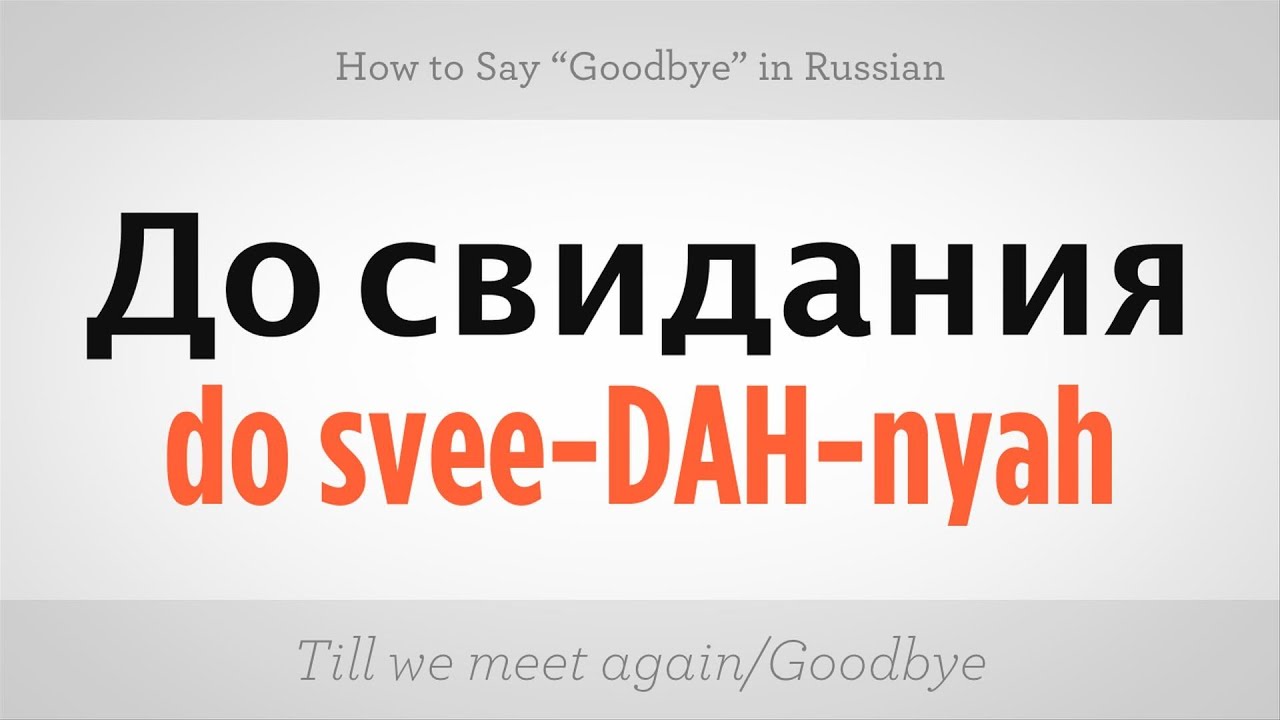
| До свидания | Goodbye | [do svidaniya] |
| Всего хорошего | All the best | [vsego khoroshevo] |
| Всего доброго | All the best | [vsego dobrovo] |
| Счастливо | Good luck | [schastlivo] |
| Удачи | Good luck | [udachi] |
These phrases can be used in a variety of situations. For example, “До свидания” is a common way to say goodbye to a colleague or acquaintance. “Всего хорошего” and “Всего доброго” are more formal ways to say goodbye, and they are often used in business settings.
“Счастливо” and “Удачи” are both ways to wish someone well, and they can be used in both formal and informal settings.
It is important to note that the cultural significance of these phrases varies depending on the context in which they are used. For example, “До свидания” is a very common phrase that can be used in a variety of situations.
However, “Всего хорошего” and “Всего доброго” are more formal phrases that are typically used in business settings. “Счастливо” and “Удачи” are both ways to wish someone well, but “Счастливо” is a more formal phrase that is typically used in written communication.
Informal Ways to Say Goodbye
In informal settings, Russians use a variety of casual phrases to say goodbye. These expressions are typically shorter and more colloquial than their formal counterparts.
Common Informal Goodbye Phrases
- Пока (pa-ka): This is the most common informal way to say goodbye. It is pronounced with a soft “k” sound and can be used in most situations.
- До встречи (da svee-chee): This phrase literally means “until we meet again” and is used to express the hope of seeing someone again in the future.
- До завтра (da zav-tra): This phrase means “until tomorrow” and is used when saying goodbye to someone you expect to see the next day.
- Всего хорошего (vseh-vo kha-ro-she-va): This phrase means “all the best” or “take care” and is used to wish someone well.
- Удачи (oo-da-chee): This phrase means “good luck” and is used to wish someone success in their endeavors.
Contextual Usage
The appropriate usage of formal and informal goodbye phrases in different social situations depends on several factors, including the level of formality in the relationship, the context of the interaction, and the cultural and societal norms of the speakers.
Formal Settings
In formal settings, such as business meetings, conferences, or official ceremonies, it is generally appropriate to use formal goodbye phrases. These phrases typically express respect and politeness, and they can help to maintain a professional tone.
- Examples of appropriate formal goodbye phrases:
- “It was a pleasure meeting you.”
- “Thank you for your time.”
- “I look forward to seeing you again soon.”
It is important to note that in some cultures, such as Japanese culture, there are specific rules and etiquette for saying goodbye in formal settings. It is important to be aware of these cultural norms and to follow them appropriately.
Informal Settings
In informal settings, such as among friends, family, or colleagues, it is generally acceptable to use informal goodbye phrases. These phrases are typically more casual and friendly, and they can help to create a more relaxed and comfortable atmosphere.
- Examples of appropriate informal goodbye phrases:
- “See you later.”
- “Take care.”
- “Have a good one.”
The choice of goodbye phrase can also be influenced by the tone and body language of the speakers. For example, a warm and friendly tone of voice can make even a formal goodbye phrase sound more informal. Conversely, a cold and distant tone of voice can make even an informal goodbye phrase sound more formal.
Cultural Significance

Saying goodbye in Russian society is not just a matter of exchanging a few words. It is a ritual that can take several minutes and involve a number of different gestures and expressions. The way you say goodbye can convey a lot about your relationship with the person you are leaving, as well as your own cultural background.
For Russians, saying goodbye is a way of showing respect and affection. It is also a way of acknowledging the importance of the relationship and the hope that you will see each other again soon.
The Importance of the Goodbye Ritual
The goodbye ritual is an important part of Russian culture. It is a way of showing respect and affection for the person you are leaving, as well as acknowledging the importance of the relationship. The ritual can vary depending on the relationship between the two people, but it typically involves a number of different gestures and expressions.
- The handshake:The handshake is a common way to say goodbye in Russia. It is typically a firm handshake, with eye contact and a smile.
- The hug:The hug is a more intimate way to say goodbye. It is typically reserved for close friends and family members.
- The kiss:The kiss is the most intimate way to say goodbye. It is typically reserved for romantic partners.
Gestures and Body Language
In Russian culture, certain gestures and body language are associated with saying goodbye. These gestures often carry cultural significance and symbolism and are used in different situations to convey specific messages.
One common gesture is the handshake, which is used in both formal and informal settings. A firm handshake is seen as a sign of respect and sincerity. When shaking hands, it is customary to make eye contact and smile.
Another common gesture is the embrace, which is used to express affection and warmth. Embraces are typically reserved for close friends and family members. When embracing, it is customary to hug the other person with both arms and pat them on the back.
In addition to these gestures, there are a number of other body language cues that can be used to say goodbye in Russian culture. These cues include:
- Waving goodbye with the hand
- Nodding the head
- Smiling
- Saying “dosvidaniya” (goodbye)
The following table summarizes the gestures and body language associated with saying goodbye in Russian culture, along with their meanings and examples of their usage:
| Gesture | Meaning | Example |
|---|---|---|
| Handshake | Respect, sincerity | When meeting a new person or saying goodbye to a friend |
| Embrace | Affection, warmth | When saying goodbye to a close friend or family member |
| Waving goodbye with the hand | Goodbye | When saying goodbye to someone who is leaving |
| Nodding the head | Goodbye | When saying goodbye to someone who is leaving |
| Smiling | Goodbye | When saying goodbye to someone who is leaving |
| Saying “dosvidaniya” (goodbye) | Goodbye | When saying goodbye to someone who is leaving |
Regional Variations
Across the vast expanse of Russia, there are regional variations in goodbye phrases and customs, reflecting the diverse cultural influences that have shaped the country.
Siberia
- In Siberia, the phrase “До свидания” (Do svidaniya) is commonly used, along with the more informal “Пока” (Poka).
- A unique custom in Siberia is the “прощальный поцелуй” (proshchalny potseluy), a farewell kiss on the cheek, often exchanged between close friends or family members.
Southern Russia
- In Southern Russia, the phrase “Всего доброго” (Vsego dobrogo) is prevalent, expressing wishes for all things good.
- Another common phrase is “Будь здоров” (Bud zdorov), which translates to “Be healthy” and conveys a sense of well-being.
Ural Mountains
- In the Ural Mountains region, the phrase “Здорово” (Zdravstvuite) is used both as a greeting and a farewell, conveying a sense of familiarity and well-being.
- A distinctive custom in the Urals is the “обнимашки” (obnimashki), a warm embrace exchanged between close acquaintances.
Historical Evolution
The Russian language has a rich and varied history, and its goodbye phrases have evolved over time to reflect the changing social and cultural landscape of the country. In the early days of Russian history, people would often say goodbye with the phrase “S Bogom” (literally, “with God”), which expressed the hope that God would protect the traveler on their journey.
This phrase is still used today, but it is more common in formal settings.
In the 18th and 19th centuries, as Russia became more Westernized, people began to adopt French and German goodbye phrases. The phrase “Do svidaniya” (literally, “until we see each other again”) became popular during this time, and it is still the most common way to say goodbye in Russian today.
Other popular goodbye phrases from this period include “Vsego dobr”ogo” (literally, “all the best”) and “Schastlivogo puti” (literally, “have a happy journey”).
In the 20th century, the Russian language underwent a number of changes, and goodbye phrases were no exception. The phrase “Poka” (literally, “until later”) became more popular, and it is now one of the most common ways to say goodbye in informal settings.
In the realm of linguistic diversity, the Russian language offers a plethora of expressions for bidding farewell. One such phrase is “dosvidaniya,” meaning “until we meet again.” Interestingly, the term “pie Jesu” holds a connection to a different linguistic realm.
What language is pie Jesu ? It is a Latin phrase commonly found in religious contexts, such as the “Requiem Mass.” Returning to Russian farewells, another common expression is “poka,” which conveys a more informal and temporary separation.
Other popular goodbye phrases from this period include “Do zavtra” (literally, “until tomorrow”) and “Do skoroi vstrechi” (literally, “until we meet again soon”).
Factors Influencing the Evolution of Goodbye Phrases in Russian
- Social and cultural changes:As Russian society has changed over time, so too have its goodbye phrases. The adoption of Western goodbye phrases in the 18th and 19th centuries is a reflection of Russia’s increasing Westernization during that period. Similarly, the popularity of the phrase “Poka” in the 20th century is a reflection of the more informal and relaxed atmosphere of that time.
- Technological advances:The development of new technologies has also had an impact on the evolution of goodbye phrases in Russian. The invention of the telephone and the internet has made it easier for people to stay in touch, and this has led to a decrease in the use of formal goodbye phrases.
Today, it is more common to say goodbye with a simple “Poka” or “Do zavtra” than it is to use a more formal phrase like “Do svidaniya.”
- Regional variations:There are also regional variations in goodbye phrases within Russia. In some regions, it is more common to use formal goodbye phrases, while in other regions, it is more common to use informal phrases. For example, the phrase “Do svidaniya” is more common in formal settings in Moscow, while the phrase “Poka” is more common in informal settings in Saint Petersburg.
Comparison of Goodbye Phrases in Russian to Those in Other Languages
Goodbye phrases in Russian are similar to those in other languages. In most languages, there is a formal goodbye phrase that is used in formal settings, and an informal goodbye phrase that is used in informal settings. However, there are some differences between goodbye phrases in Russian and those in other languages.
- In Russian, it is more common to use a formal goodbye phrase when saying goodbye to someone who is older or who you do not know well.This is a sign of respect. In other languages, it is more common to use an informal goodbye phrase, regardless of the age or relationship of the people involved.
- In Russian, there is a wider range of goodbye phrases than in other languages.This is because Russian has a rich and varied history, and its goodbye phrases have evolved over time to reflect the changing social and cultural landscape of the country.
Regional Variations in Goodbye Phrases Within Russia
There are some regional variations in goodbye phrases within Russia. In some regions, it is more common to use formal goodbye phrases, while in other regions, it is more common to use informal phrases. For example, the phrase “Do svidaniya” is more common in formal settings in Moscow, while the phrase “Poka” is more common in informal settings in Saint Petersburg.
These regional variations are a reflection of the different cultures and traditions of the different regions of Russia. In general, the more formal goodbye phrases are used in the more urban and cosmopolitan areas of Russia, while the more informal goodbye phrases are used in the more rural and traditional areas of Russia.
Comparison with Other Languages

Russian goodbye phrases share similarities and exhibit unique differences when compared to those used in other languages.
In many languages, the most common way to say goodbye is with a simple “goodbye” or its equivalent. In Russian, however, there are multiple ways to say goodbye, each with its own specific connotation and level of formality.
English
The English language has a relatively limited number of goodbye phrases. The most common phrase is simply “goodbye,” which can be used in most situations. Other common phrases include “bye,” “see you later,” and “take care.”
Spanish
Spanish has a more extensive repertoire of goodbye phrases than English. The most common phrase is “adiós,” which can be used in both formal and informal situations. Other common phrases include “hasta luego” (until later), “hasta mañana” (until tomorrow), and “que te vaya bien” (may it go well with you).
French
French has a similar range of goodbye phrases to Spanish. The most common phrase is “au revoir,” which can be used in both formal and informal situations. Other common phrases include “à bientôt” (see you soon), “bonne journée” (have a good day), and “bonne soirée” (have a good evening).
Similarities
Despite their differences, Russian goodbye phrases share some similarities with those used in other languages. For example, many languages have a phrase that means “until later” or “see you again.” Additionally, many languages have a phrase that is used to wish someone well on their journey.
Differences
The main difference between Russian goodbye phrases and those used in other languages is the level of formality. In Russian, there are distinct phrases that are used in formal and informal situations. This is not the case in many other languages, where the same phrase can be used in both settings.
Etiquette and Customs
When saying goodbye in Russian culture, there are certain etiquette and customs that should be observed. These customs vary depending on the formality of the situation and the relationship between the individuals involved.
In general, it is considered polite to make eye contact and smile when saying goodbye. It is also important to use the appropriate level of formality in your language. For example, when saying goodbye to a close friend, you would use informal language, while when saying goodbye to a superior or someone you do not know well, you would use formal language.
Common Phrases
There are a number of common phrases that are used to say goodbye in Russian. Some of the most common phrases include:
- До свидания(do svidaniya) – This is the most common way to say goodbye in Russian. It can be used in both formal and informal situations.
- Пока(poka) – This is a more informal way to say goodbye. It is often used between friends and family members.
- Всего доброго(vsego dobrogo) – This phrase means “all the best” and is often used when saying goodbye to someone you may not see again for a while.
- Счастливо(schastlivo) – This phrase means “be happy” and is often used when saying goodbye to someone you care about.
Body Language and Gestures
In addition to verbal communication, body language and gestures can also play a role in saying goodbye in Russian culture. Some of the most common body language and gestures include:
- Shaking hands– Shaking hands is a common way to say goodbye in Russian culture. It is typically done with a firm handshake and direct eye contact.
- Hugging– Hugging is another common way to say goodbye in Russian culture. It is typically done between friends and family members.
- Waving– Waving is a more informal way to say goodbye. It is often done when saying goodbye to someone who is leaving or who you may not see again for a while.
Tone and Emotion
The tone of voice and emotions can significantly influence the meaning of goodbye phrases in Russian. The same phrase can convey different messages depending on how it is said.
For example, the phrase “Do svidaniya” (goodbye) can be said with a neutral tone to indicate a polite farewell. However, if it is said with a warm and friendly tone, it can convey a sense of affection and closeness. Conversely, if it is said with a cold and distant tone, it can indicate a lack of interest or even hostility.
Tone of Voice and Emotion
| Tone of Voice | Emotion | Meaning |
|---|---|---|
| Neutral | Polite | A polite farewell |
| Warm and friendly | Affection | A sense of affection and closeness |
| Cold and distant | Disinterest or hostility | A lack of interest or even hostility |
| Sad | Regret | A sense of regret or sadness |
| Happy | Joy | A sense of joy or happiness |
| Angry | Anger | A sense of anger or frustration |
Cultural Nuances

Saying goodbye in Russian society is generally polite and respectful. There are certain cultural nuances and unspoken rules to be aware of to ensure a proper farewell.
One important nuance is the use of the patronymic name when saying goodbye to someone who is older or in a position of authority. The patronymic name is the father’s first name with the suffix “-ovich” or “-ovna” added to it.
For example, if someone’s name is Ivan Petrovich Ivanov, you would address them as “Ivan Petrovich” when saying goodbye.
Eye Contact
Maintaining eye contact when saying goodbye is considered a sign of respect. It shows that you are paying attention to the person you are speaking to and that you are sincere in your farewell.
Handshake
A handshake is a common way to say goodbye in Russian society. However, it is important to note that the handshake should be firm and brief. A limp handshake can be seen as a sign of weakness or disinterest, while a handshake that is too strong can be seen as aggressive.
Hugs and Kisses, How to say goodbye in russian language
Hugs and kisses are generally not used as a way to say goodbye in Russian society. However, they may be used between close friends or family members.
Polite and Respectful Phrases: How To Say Goodbye In Russian Language

When expressing goodbye in Russian, there are various polite and respectful phrases that can be employed in different situations.
The Russian language offers various ways to bid farewell. One common expression is “dosvidaniya,” which translates to “until we see each other again.” Alternatively, “proshchay” is used for more formal goodbyes. Italy’s official language is Italian, a Romance language descended from Latin.
The Italian language is spoken by around 60 million people worldwide, primarily in Italy, Switzerland, San Marino, and Vatican City. Returning to Russian farewells, “poka” is a casual way to say goodbye, while “vsego dobr” means “all the best.”
These phrases demonstrate consideration and respect for the person you are addressing, and they are particularly suitable for formal settings or when interacting with individuals you hold in high regard.
Common Polite Phrases
- До свидания (Do svidaniya):This is the most common and versatile phrase for saying goodbye, suitable for most situations.
- Всего доброго (Vsego dobrogo):Meaning “all the best,” this phrase conveys well wishes and is appropriate for both formal and informal settings.
- Всего хорошего (Vsego khoroshego):Similar to the previous phrase, this one also means “all the best” and is commonly used in formal contexts.
- Счастливо оставаться (Schastlivo ostavat’sya):This phrase translates to “stay happy” and is a polite way to express goodbye, wishing the person well.
- Удачи (Udachi):Meaning “good luck,” this phrase is a concise and respectful way to bid farewell, especially when the person is embarking on a new endeavor.
Humorous or Affectionate Phrases

In addition to the formal and informal goodbye phrases discussed earlier, there are also a number of humorous or affectionate phrases that are commonly used among friends and family.
These phrases often convey a sense of camaraderie or closeness, and they can be a fun way to end a conversation.
Examples
Here are a few examples of humorous or affectionate goodbye phrases:
- “See you later, alligator.”
- “After a while, crocodile.”
- “Toodle-oo.”
- “Ciao, bella.”
- “Take care, my dear.”
These phrases are often used in informal settings, such as among friends or family members. They can also be used in more formal settings, such as at work or school, but it is important to be aware of the context and to use them appropriately.
Literary and Artistic Expressions
Goodbye phrases in Russian literature and art have a profound emotional and thematic significance. They reflect the cultural and historical context of the time and often serve as powerful expressions of farewell, loss, and longing.
Examples in Russian Literature
In Alexander Pushkin’s novel Eugene Onegin, the protagonist’s farewell to Tatiana is a poignant and heartbreaking moment. The phrase “Прощай, Татьяна” (“Farewell, Tatiana”) encapsulates the deep sorrow and regret of a love unrequited.
In Fyodor Dostoevsky’s Crime and Punishment, the character Sonya’s farewell to Raskolnikov is a moment of redemption and forgiveness. The phrase “Прощай, Родион” (“Farewell, Rodion”) symbolizes the possibility of redemption even in the darkest of times.
Examples in Russian Poetry
Goodbye phrases are also prevalent in Russian poetry. In Anna Akhmatova’s poem “Прощание” (“Farewell”), the speaker’s farewell to a lost love is expressed through the repeated phrase “Прощай, прощай, прощай” (“Farewell, farewell, farewell”).
In Osip Mandelstam’s poem “Я не увижу больше” (“I Will Not See Anymore”), the speaker’s farewell to his homeland is conveyed through the line “Прощай, страна, прощай, родная” (“Farewell, country, farewell, my homeland”).
Cultural and Historical Context
The usage of goodbye phrases in Russian art forms is influenced by the cultural and historical context of the time. In the 19th century, the Romantic movement emphasized the importance of emotion and individuality, leading to a greater focus on personal farewells and expressions of loss.
During the Soviet era, goodbye phrases often took on a political and ideological significance, reflecting the collectivist ethos of the time. The phrase “Прощай, товарищ” (“Farewell, comrade”) became a common way to bid farewell to a fellow party member.
Role of Language, Symbolism, and Imagery
Goodbye phrases in Russian literature and art are often used to convey a range of emotions and themes, from sorrow and regret to hope and redemption. The language, symbolism, and imagery used in these phrases play a crucial role in shaping their emotional impact.
For example, the use of repetition in Akhmatova’s poem “Прощание” creates a sense of urgency and longing, while the imagery of “country” and “homeland” in Mandelstam’s poem “Я не увижу больше” evokes a deep sense of loss and displacement.
Reflection of Broader Themes
Goodbye phrases in Russian literature and art reflect the broader themes and messages of Russian culture. They explore the themes of love, loss, longing, and redemption, and provide a glimpse into the Russian soul.
Through the use of goodbye phrases, Russian artists have captured the essence of the human experience, expressing the universal emotions and experiences of farewell and loss.
Modern Trends and Influences
The Russian language is constantly evolving, and the way people say goodbye is no exception. In recent years, several modern trends and influences have shaped how Russians bid farewell to each other.
One of the most significant influences is the rise of social media. Social media platforms like VKontakte and Instagram have made it easier for people to stay connected with friends and family who live far away. As a result, Russians are now more likely to say goodbye to each other online, using text messages, emojis, and video calls.
Influence of Technology
Technology has also played a role in shaping the way Russians say goodbye. The widespread use of smartphones and tablets has made it possible for people to stay connected with each other even when they are not physically present. This has led to the development of new ways to say goodbye, such as sending a text message or leaving a voicemail.
Influence of Western Culture
The influence of Western culture has also had an impact on the way Russians say goodbye. In recent years, Russians have become more exposed to Western media, such as movies, TV shows, and music. This exposure has led to the adoption of some Western goodbye phrases, such as “see you later” and “take care.”
FAQ Summary
What is the most common way to say goodbye in Russian?
The most common way to say goodbye in Russian is “Do svidaniya” (До свидания), which translates to “Until we meet again.”
Is it considered rude to say goodbye in Russian without shaking hands?
In most situations, it is not considered rude to say goodbye in Russian without shaking hands. However, in formal settings or when meeting someone for the first time, it is considered polite to shake hands as a gesture of respect.
Are there any regional variations in goodbye phrases in Russia?
Yes, there are some regional variations in goodbye phrases in Russia. For example, in the southern regions of Russia, it is common to say “Pokeka” (Пока) instead of “Do svidaniya.”
