How to tell time in German language: A comprehensive guide to understanding and expressing time accurately in German, covering essential vocabulary, grammar rules, and cultural nuances.
This guide delves into the intricacies of German time-telling, providing a structured and comprehensive approach to mastering this fundamental aspect of the language.
Introduction

Time is a fundamental concept in the German language, just as it is in any other language. It plays a crucial role in everyday communication, as we often need to refer to specific times or durations. Whether it’s scheduling appointments, catching trains, or simply planning our day, understanding how to tell time in German is essential for effective communication and daily life.
Telling time accurately is not just a matter of convenience; it can also have practical implications. For instance, being punctual for appointments or meetings demonstrates respect for others and helps maintain a positive professional image. Moreover, understanding time expressions is crucial for comprehending spoken and written German, as time-related words and phrases are commonly used in various contexts.
Basic Vocabulary

Telling time in German requires familiarity with specific vocabulary for hours, minutes, seconds, and other related concepts. This vocabulary forms the foundation for understanding and expressing time accurately.
The following table provides a comprehensive list of essential German vocabulary for telling time, organized into categories for easy reference:
German Vocabulary for Telling Time
| German | English | Pronunciation |
|---|---|---|
| Uhr | o’clock | /ʊɐ̯/ |
| Stunde | hour | /ˈʃtʊndə/ |
| Minute | minute | /miˈnuːtə/ |
| Sekunde | second | /zeˈkʊndə/ |
| viertel | quarter | /ˈfɪʁtl̩/ |
| halb | half | /halp/ |
| nach | past | /naːx/ |
| vor | to | /foːɐ̯/ |
Telling Time on the Hour

In German, telling time on the hour is relatively straightforward. The basic structure is to use the word “Uhr” (hour) followed by the number of the hour.
For example:
- “Es ist eins Uhr” (It is one o’clock)
- “Es ist zwei Uhr” (It is two o’clock)
- “Es ist drei Uhr” (It is three o’clock)
Example 1: Telling Time on the Half Hour
To express “half past one” in German, we use the phrase “halb zwei”.
Pronunciation Guide
- halb: hahlp
- zwei: tsvy
Telling Time in Minutes

In German, telling time in minutes follows a specific pattern. To express the minutes, use the following structure:
[number] Uhr [minutes] Minuten
For example, to say “10:15,” you would say ” zehn Uhr fünfzehn Minuten.”
Special Cases
There are a few special cases to keep in mind when telling time in minutes:
- On the hour:When the minutes are zero, simply say ” Uhr” without specifying the minutes. For example, “10:00″ is ” zehn Uhr.”
- Quarter past the hour:To say “quarter past the hour,” use the phrase ” viertel nach.” For example, “10:15″ is ” viertel nach zehn.”
- Half past the hour:To say “half past the hour,” use the phrase ” halb.” For example, “10:30″ is ” halb elf.”
- Quarter to the hour:To say “quarter to the hour,” use the phrase ” viertel vor.” For example, “10:45″ is ” viertel vor elf.”
Telling Time in Seconds: How To Tell Time In German Language
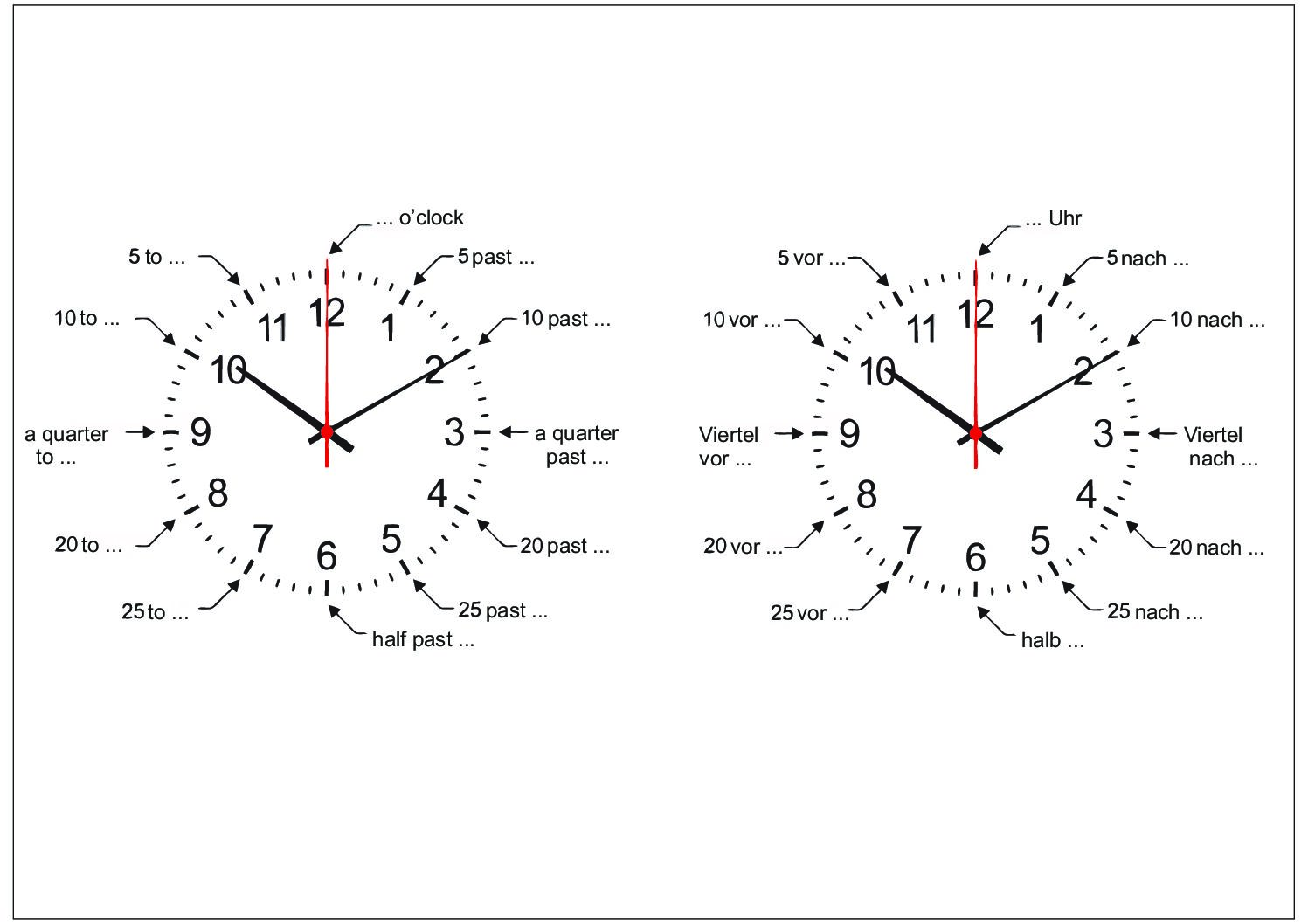
In German, seconds are expressed using the word “Sekunde”. To tell time in seconds, you simply state the number of seconds after the minute.
For example, to say “it is 10:15 and 30 seconds”, you would say “Es ist 10 Uhr 15 und 30 Sekunden”.
Using “nach”
You can also use the preposition “nach” (after) to indicate seconds. For example, you could say “Es ist 10 Uhr 15 nach 30 Sekunden” (It is 10:15 after 30 seconds).
Using Time Prepositions
Time prepositions in German are used to indicate the relationship between a point in time and an event or action. The most common time prepositions are:
- um– at, around
- in– in, at
- von…bis– from…to
- vor– before
- nach– after
These prepositions can be used with both specific and general times.
Specific Times
When using time prepositions with specific times, the preposition is placed before the time.
- um 8 Uhr– at 8 o’clock
- in 10 Minuten– in 10 minutes
- von 9 bis 11 Uhr– from 9 to 11 o’clock
- vor 12 Uhr– before 12 o’clock
- nach 13 Uhr– after 13 o’clock
General Times
When using time prepositions with general times, the preposition is placed after the time.
- morgens um 8 Uhr– in the morning at 8 o’clock
- abends in 10 Minuten– in the evening in 10 minutes
- nachmittags von 9 bis 11 Uhr– in the afternoon from 9 to 11 o’clock
- vormittags vor 12 Uhr– in the morning before 12 o’clock
- nachmittags nach 13 Uhr– in the afternoon after 13 o’clock
Telling Time in Different Contexts
Telling time is a crucial aspect of communication that varies depending on the context. Understanding how to express time appropriately in different settings is essential for effective interaction.
Telling time in German can be tricky at first, but with a little practice, it becomes much easier. To say “it is 3:15,” you would say “Es ist Viertel nach drei.” For “it is 10:45,” you would say “Es ist Viertel vor elf.” If you want to say “it is 12:00,” you would say “Es ist Mittag.” For more information on how to tell time in German, please refer to the following resource: How to Write Korean Language in Korean.
Formal Settings
In formal settings, such as business meetings or academic presentations, it is customary to use the 24-hour clock. This format provides precision and avoids confusion that may arise from the 12-hour clock’s use of “a.m.” and “p.m.” Additionally, formal settings typically require the avoidance of contractions and slang.
- Example: “The conference will commence at 14:00 hours.” (2:00 p.m.)
Informal Settings
In informal settings, such as casual conversations or social gatherings, the 12-hour clock is more commonly used. Contractions and slang are also acceptable in these contexts, making the expression of time more conversational.
- Example: “We’re meeting up at 3 o’clock.” (3:00 p.m.)
Cultural Differences
Cultural differences can also influence how time is expressed. In some cultures, punctuality is highly valued, and being late is considered impolite. In other cultures, it is more acceptable to be late, and appointments may not be taken as strictly.
It is important to be aware of the cultural context when expressing time to avoid misunderstandings.
When telling time in German, it is important to remember that the numbers are slightly different from English. For example, “one” is “eins” and “two” is “zwei”. Additionally, the word for “o’clock” is “Uhr”. If you want to ask someone what time it is, you would say “Wie spät ist es?”.
While German is the official language of Germany, Austria, and Liechtenstein, it is also spoken in other countries, such as Tunisia. When telling time in German, it is also important to remember that the 24-hour clock is often used.
- Example: In Germany, punctuality is generally expected, while in Mexico, it is more acceptable to be late.
Table: Key Phrases and Expressions for Telling Time
The following table summarizes key phrases and expressions used in different contexts for telling time:| Context | Key Phrases | Expressions ||—|—|—|| Formal | 14:00 hours | Commence at || Informal | 3 o’clock | Meet up at || Cultural | Punctuality | Acceptable to be late |
Cultural Aspects of Time

Time plays a significant role in German-speaking cultures, shaping social interactions, daily routines, and even artistic expressions. The concept of “German time” is widely recognized, emphasizing punctuality and adherence to schedules.
In Germany, punctuality is highly valued. Arriving late for appointments or social events is generally considered disrespectful and may lead to negative consequences. This emphasis on punctuality extends to public transportation, where trains and buses typically run on time. However, in some social settings, such as informal gatherings or among friends, a more relaxed approach to time may be acceptable.
Punctuality in Different German-Speaking Cultures
While punctuality is generally important in German-speaking countries, there are subtle differences in its interpretation and significance across different cultures.
- Germany:Punctuality is highly valued and considered a sign of respect. Arriving late may be seen as disrespectful or unprofessional.
- Austria:Punctuality is also important, but there is a slightly more relaxed approach compared to Germany. Arriving a few minutes late for social events is generally acceptable.
- Switzerland:Punctuality is of utmost importance, and arriving late is considered highly disrespectful. Trains and buses run with extreme precision, and tardiness is frowned upon.
Time in German Literature, Art, and Music
Time is a recurring theme in German literature, art, and music, reflecting the cultural significance attached to it.
- Literature:German literature often explores the themes of time’s passage, mortality, and the search for meaning in a constantly changing world. Works by authors such as Goethe, Schiller, and Thomas Mann delve into the complexities of time and its impact on human experience.
- Art:German artists have used time as a subject and a medium in various ways. For example, the works of Albrecht Dürer and Caspar David Friedrich often depict scenes that convey a sense of timelessness or the transience of life.
- Music:German composers have explored time through musical forms and techniques. Ludwig van Beethoven’s Ninth Symphony, for instance, features a famous choral movement that includes the text “Ode to Joy,” which celebrates the unity of humanity and the passage of time.
Time in German Culture, How to tell time in german language
Time is deeply ingrained in German culture, influencing daily routines and social interactions.
- Timetables:Germans are known for their adherence to timetables. Public transportation, work schedules, and social events are typically organized according to precise schedules.
- Importance of Punctuality:Punctuality is highly valued in German society. Being late for appointments or meetings is generally considered rude and may have negative consequences.
- Concept of “Gemütlichkeit”:“Gemütlichkeit” is a German concept that encompasses a sense of warmth, coziness, and well-being. It often involves spending time with loved ones, enjoying good food and drinks, and creating a comfortable and relaxing atmosphere.
Time Zones in Germany

Germany lies in the Central European Time (CET) zone, which is one hour ahead of Coordinated Universal Time (UTC) during standard time and two hours ahead during daylight saving time. However, due to its large size, Germany also has a small portion of its territory that lies in the Eastern European Time (EET) zone, which is two hours ahead of UTC during standard time and three hours ahead during daylight saving time.
The following table provides an overview of the time zones in Germany:
| Time Zone | Abbreviation | UTC Offset |
|---|---|---|
| Central European Time | CET | +1:00 |
| Eastern European Time | EET | +2:00 |
Historically, Germany has undergone several changes in its time zones. Prior to 1893, Germany had a variety of local time zones, each based on the local mean solar time. In 1893, Germany adopted the Central European Time zone, which was one hour ahead of Greenwich Mean Time (GMT).
In 1940, during World War II, Germany adopted the Eastern European Time zone, which was two hours ahead of GMT. After the war, Germany returned to the Central European Time zone. In 1980, Germany adopted daylight saving time, which is observed from the last Sunday in March to the last Sunday in October.
The time zone differences in Germany have a significant impact on daily life. For example, people living in the EET zone have to adjust their schedules by one hour when traveling to the CET zone. This can be particularly challenging for people who work or study in the CET zone and live in the EET zone.
There are both pros and cons to having multiple time zones in Germany. On the one hand, it can be convenient for people who live near the border between the two time zones. On the other hand, it can be confusing for people who travel frequently between the two time zones.
Idioms and Expressions Related to Time
Time is an essential aspect of human life, and it is no wonder that it has given rise to a wealth of idioms and expressions in German. These phrases often convey a deeper meaning or nuance that goes beyond the literal translation of the words.
Here is a list of some common German idioms and expressions related to time, along with their meanings:
Common Idioms and Expressions
- Zeit ist Geld:Time is money.
- Die Zeit rennt:Time is running away.
- Zeit heilt alle Wunden:Time heals all wounds.
- Morgenstund hat Gold im Mund:The early bird catches the worm.
- Wer die Zeit nicht ehrt, den ehrt sie auch nicht:Those who do not honor time will not be honored by it.
Time Conversion
Understanding time zones is crucial for effective global communication and coordination. Time zones are regions of the world that observe a uniform standard time for legal, commercial, and social purposes. They are defined by their offset from Coordinated Universal Time (UTC), the primary time standard by which the world regulates clocks and time.
Time Zone Offsets
Time zones are typically expressed as offsets from UTC, ranging from UTC-12:00 to UTC+14: 00. The following table lists some common time zones and their corresponding offsets:
| Time Zone | Offset from UTC |
|---|---|
| UTC | +00:00 |
| Eastern Time (US and Canada) | -05:00 |
| Central European Time | +01:00 |
| Japan Standard Time | +09:00 |
| Australian Eastern Standard Time | +10:00 |
Converting Time Between Time Zones
To convert time between time zones, follow these steps:
- Determine the time zone offset between the two locations.
- Add the offset to the time in the original time zone if the destination time zone is ahead.
- Subtract the offset from the time in the original time zone if the destination time zone is behind.
Code Snippet
The following code snippet demonstrates how to convert time between time zones using the Python datetime module:
“`pythonfrom datetime import datetime, timezone# Create a datetime object for a specific time in a specific time zonedt = datetime(2023, 3, 8, 15, 30, tzinfo=timezone(timedelta(hours=-5)))# Convert the datetime object to another time zonedt_converted = dt.astimezone(timezone(timedelta(hours=+1)))# Print the converted datetime objectprint(dt_converted)“`
Importance of Understanding Time Zones
“Understanding time zones is essential for businesses operating globally, as it ensures efficient coordination of meetings, deadlines, and other time-sensitive activities.”
David Walsh, Senior Software Engineer
Resources for Learning German Time
If you want to master the art of telling time in German, numerous resources are available to assist you on your learning journey. These resources encompass websites, books, and apps, each providing unique advantages to enhance your understanding.
Websites offer a convenient and accessible platform for learning German time. They often feature interactive exercises, grammar explanations, and audio recordings to reinforce your comprehension. Books, on the other hand, provide a structured and comprehensive approach, allowing you to delve deeper into the intricacies of German time-telling.
Apps offer a portable and engaging way to practice your skills. They often incorporate gamified elements and personalized learning paths to make the learning process enjoyable and tailored to your individual needs.
Websites
- Deutsche Welle: https://www.dw.com/en/learn-german/german-courses/a-15284163
- Goethe-Institut: https://www.goethe.de/en/spr/ueb/zeit.html
- Lernu!: https://www.lernu.net/en/course/german/time
Books
- German for Dummies: https://www.dummies.com/languages/german/german-for-dummies-cheat-sheet/
- Teach Yourself German: https://www.amazon.com/Teach-Yourself-German-Complete-Course/dp/0071775542
- Colloquial German: https://www.routledge.com/Colloquial-German-5th-Edition-The-Complete-Course-for-Beginners/Weber-Erb/p/book/9781138732210
Apps
- Duolingo: https://www.duolingo.com/course/de/en/Learn-German
- Babbel: https://www.babbel.com/learn-german
- Rosetta Stone: https://www.rosettastone.com/learn-german
User Queries
How do I say “half past one” in German?
halb zwei
What is the difference between “halb” and “halbe” when telling time?
“Halb” is used for masculine and neuter nouns, while “halbe” is used for feminine nouns.
How do I tell time in minutes in German?
Use the following format: “number of minutes past the hour” + “Uhr” (e.g., “fünfzehn Uhr” for 3:15)
