How to say hello how are you in korean language – In Korean culture, greetings play a crucial role in social interactions, conveying respect, politeness, and warmth. This guide will delve into the nuances of Korean greetings, providing you with the essential phrases and cultural insights to navigate social situations confidently.
We will explore how to say “hello” and ask “how are you?” in both formal and informal settings, ensuring that you make a positive and lasting impression.
Korean Language Greetings

Greetings are an essential part of Korean culture, reflecting the importance of respect, politeness, and social hierarchy. They serve as a way to show respect, establish relationships, and maintain social harmony.
Korean greetings vary depending on the formality of the situation, the relationship between the speakers, and the time of day. There are both formal and informal greetings, and it is important to use the appropriate greeting in each situation.
Common Korean Greetings
The following table provides a list of common Korean greetings and their English translations:
| Korean Greeting | English Translation | Formality |
|---|---|---|
| 안녕하세요 (Annyeonghaseyo) | Hello | Formal |
| 안녕 (Annyeong) | Hi | Informal |
| 잘 지내세요? (Jal jinaeseyo?) | How are you? | Formal |
| 잘 지내? (Jal jinae?) | How are you? | Informal |
| 수고하세요 (Sugohaseyo) | Thank you for your hard work | Formal |
| 고마워요 (Gomawoyo) | Thank you | Informal |
Cultural Significance of Bowing
Bowing is an important part of Korean culture and is used as a sign of respect. There are different types of bows, each with its own meaning. The deeper the bow, the more respect is being shown.
- Slight bow (15-30 degrees):Used for casual greetings and when meeting someone for the first time.
- Standard bow (45 degrees):Used for more formal greetings and when meeting someone you know well.
- Deep bow (90 degrees):Used to show deep respect or gratitude, such as when meeting an elder or a superior.
Use of Honorifics
Honorifics are used in Korean to show respect for the person you are speaking to. Honorifics are added to the end of a person’s name or title. The most common honorific is “-nim,” which is used for people who are older, have a higher social status, or are in a position of authority.
For example, if you are speaking to a teacher, you would say “선생님 (seonsaengnim)” instead of just “선생 (seonsaeng).” Honorifics are also used when referring to people in the third person.
Examples of Greetings
The following are examples of how to greet someone in different situations:
- Meeting a friend:안녕 (Annyeong)
- Meeting a stranger:안녕하세요 (Annyeonghaseyo)
- Meeting an elder:안녕하세요 (Annyeonghaseyo) and bow
- Meeting a superior:안녕하세요 (Annyeonghaseyo) and bow deeply
Saying Hello
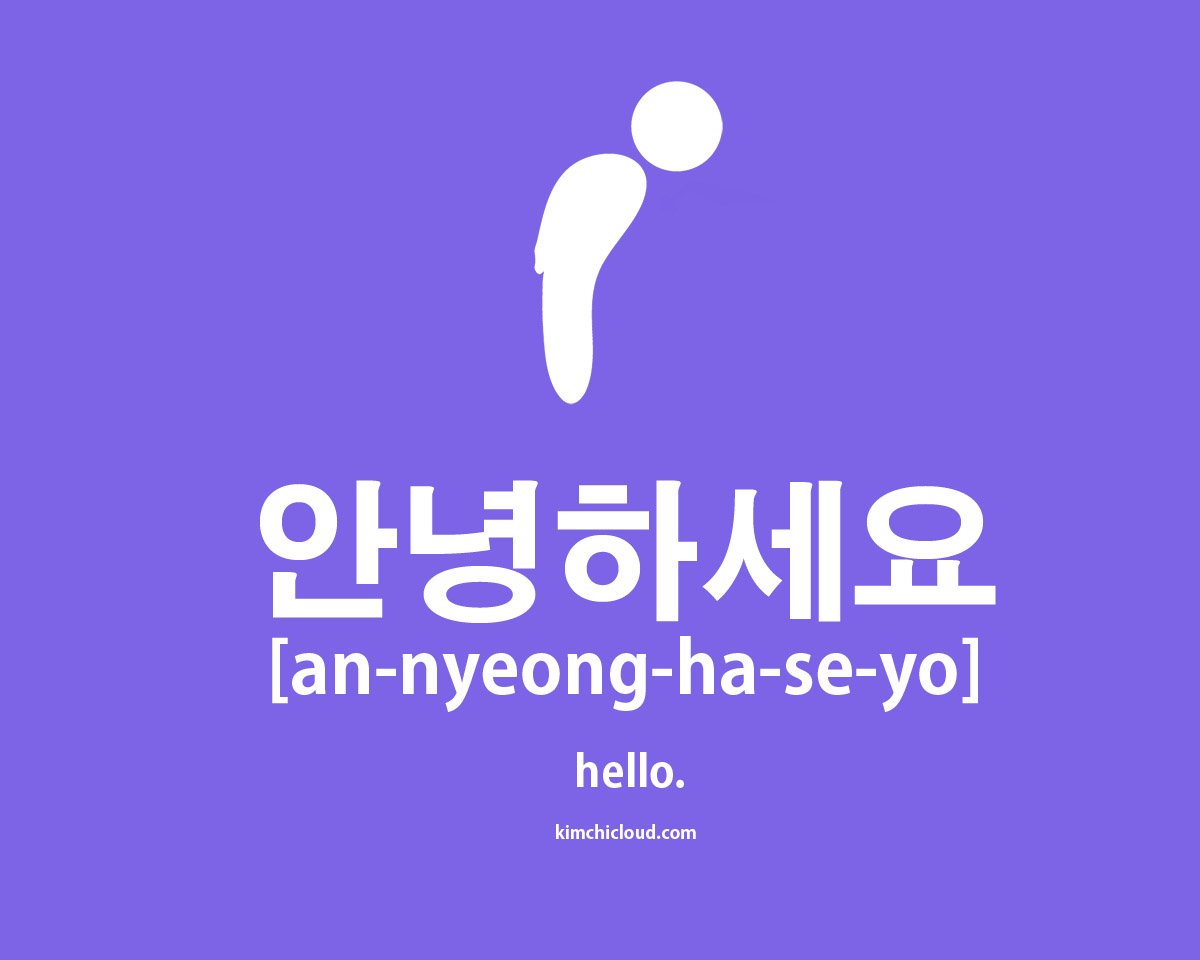
In Korean, there are two main ways to say “hello”: formally and informally. The formal way is used in more formal settings, such as when meeting someone for the first time or when speaking to someone who is older or in a position of authority.
The informal way is used in more casual settings, such as when speaking to friends or family.
Formal Way
- The formal way to say “hello” in Korean is “안녕하세요” (annyeonghaseyo).
- This phrase is pronounced “ahn-nyong-hah-say-oh”.
- It is typically used in formal settings, such as when meeting someone for the first time or when speaking to someone who is older or in a position of authority.
Informal Way
- The informal way to say “hello” in Korean is “안녕” (annyeong).
- This phrase is pronounced “ahn-nyong”.
- It is typically used in informal settings, such as when speaking to friends or family.
Tips for Pronouncing the Korean Word for “Hello”
- The “a” in “안녕하세요” (annyeonghaseyo) is pronounced like the “a” in “father”.
- The “n” in “안녕하세요” (annyeonghaseyo) is pronounced like the “n” in “no”.
- The “y” in “안녕하세요” (annyeonghaseyo) is pronounced like the “y” in “yes”.
- The “o” in “안녕하세요” (annyeonghaseyo) is pronounced like the “o” in “go”.
- The “ng” in “안녕하세요” (annyeonghaseyo) is pronounced like the “ng” in “sing”.
Asking “How Are You?”
In Korean, there are both formal and informal ways to ask “How are you?”. The appropriate form to use depends on the context and the relationship between the speakers.
To ask “How are you?” formally, use the phrase “어떻게 지내세요?” (eotteoke jinaeseyo?). This phrase is typically used in professional settings or when speaking to someone who is older or more senior than you.
To ask “How are you?” informally, use the phrase “어때요?” (eottaeyo?). This phrase is typically used in casual settings or when speaking to someone who is younger or the same age as you.
Appropriate Responses
There are a number of appropriate responses to the question “How are you?”. Some common responses include:
- “잘 지내요.” (jal jinaeyo) – I’m doing well.
- “괜찮아요.” (gwaenchanaeyo) – I’m okay.
- “별로예요.” (byeolroeyo) – I’m not doing so well.
- “힘들어요.” (himdeureoyo) – I’m having a hard time.
Cultural Etiquette
When asking or answering the question “How are you?” in Korean, it is important to be mindful of the cultural etiquette surrounding this question. In Korean culture, it is considered polite to ask about someone’s well-being, even if you do not know them well.
However, it is also important to be respectful of the person’s privacy. If someone does not want to answer the question, it is perfectly acceptable to say so.
Responding to “How Are You?”
In Korean culture, responding to the question “how are you?” is more than just a formality. It is an opportunity to express genuine concern and show respect for the person you are speaking to. There are a range of polite and appropriate responses you can give, each with its own cultural significance.
Polite Responses
- 잘 지내요? (Jal jinaeyo?): This is the most common and polite way to respond to “how are you?” It translates to “Are you doing well?” and is appropriate for most social situations.
- 괜찮아요. (Gwaenchanhayo.): This response means “I’m okay” or “I’m fine.” It is a bit more casual than “잘 지내요?” and is often used among friends and family.
- 잘 지냈어요. (Jal jinass-eoyo.): This response means “I’ve been doing well.” It is typically used when you are responding to someone you haven’t seen in a while.
- 고맙습니다. (Gomapseumnida.): This response means “thank you.” It is a polite way to acknowledge the other person’s concern and is appropriate for any social situation.
Tips for Responding
When responding to “how are you?” in Korean, it is important to consider the social situation and the relationship you have with the person you are speaking to. Here are a few tips to help you respond appropriately:
- Be sincere.Your response should be genuine and reflect how you are actually feeling.
- Be respectful.Always use polite language, even if you are speaking to someone you know well.
- Consider the context.Your response should be appropriate for the situation. For example, if you are at a funeral, you would not say “I’m doing great!”
- Don’t be afraid to ask for help.If you are not sure how to respond, you can always ask the other person for help.
Cultural Context
Greetings in Korean are highly influenced by the cultural context, particularly the level of formality and the relationship between the speakers. Korean society places great importance on hierarchy and respect, which is reflected in the language used for greetings.
Level of Formality
The level of formality in a greeting depends on several factors, including the age, social status, and familiarity between the speakers. Formal greetings are used in situations where there is a significant difference in status or when meeting someone for the first time.
Informal greetings are used among friends, family, and peers.
Relationship between Speakers
The relationship between the speakers also influences the choice of greeting. Close friends and family members may use informal greetings, while strangers or acquaintances may use more formal greetings. The level of intimacy between the speakers also affects the choice of greeting.
Situational Variations
Greetings can also vary depending on the situation. For example, the greeting used when meeting someone for the first time may be different from the greeting used when saying goodbye. The time of day and the location of the meeting can also influence the choice of greeting.
Regional Variations

Korean greetings exhibit regional variations due to historical, geographical, and cultural factors.
Busan
- Informal: 안녕하세요 (Annyeonghaseyo)
- Formal: 안녕하십니까? (Annyeong hasimnikka?)
- Casual: 안녕 (Annyeong)
Gyeongsang
- Informal: 안녕하세요 (Annyeonghaseyo)
- Formal: 안녕하십니까? (Annyeong hasimnikka?)
- Casual: 안녕하십니까? (Annyeong hasimnikka?) (with a slightly higher intonation)
Jeolla
- Informal: 안녕하세요 (Annyeonghaseyo)
- Formal: 안녕하십니까? (Annyeong hasimnikka?)
- Casual: 안녕하세요 (Annyeonghaseyo) (with a softer intonation)
These variations reflect the diverse regional cultures and historical influences that have shaped Korean society.
Non-Verbal Communication
Non-verbal communication plays a crucial role in Korean greetings. It conveys respect, politeness, and helps establish a positive rapport.Non-verbal cues include eye contact, facial expressions, gestures, and body language. Eye contact is considered a sign of respect and sincerity. Koreans generally maintain moderate eye contact during greetings, avoiding prolonged staring or averted gazes.
Facial expressions should be pleasant and respectful, with a slight smile or bow.Gestures and body language also convey important messages. Bowing is a common form of greeting, with the depth and duration of the bow indicating the level of respect.
Standing straight and maintaining an upright posture demonstrates confidence and respect.
Dialogue Demonstrating Non-Verbal Cues
Person A:(Walks towards Person B, maintains eye contact, and smiles slightly.) Person B:(Returns the smile, bows slightly, and maintains eye contact.) Person A:(Bows slightly, maintains eye contact, and extends a hand for a handshake.) Person B:(Accepts the handshake, maintains eye contact, and smiles.)This dialogue illustrates appropriate non-verbal cues for a polite and respectful greeting in Korean culture.
Formal vs. Informal Greetings
In Korean language, there are two main types of greetings: formal and informal. Formal greetings are used in situations where there is a power differential between the speaker and the listener, such as when speaking to an elder, a superior, or a stranger.
Informal greetings are used in situations where the speaker and the listener are on equal footing, such as when speaking to a friend or family member.
The following table compares the two types of greetings:
| Greeting | Formal | Informal |
|---|---|---|
| Hello | 안녕하세요 (Annyeonghaseyo) | 안녕 (Annyeong) |
| How are you? | 잘 지내세요? (Jal jinaeseyo?) | 잘 지내? (Jal jinae?) |
| Nice to meet you | 만나서 반갑습니다 (Mannaseo bangapseumnida) | 만나서 반가워요 (Mannaseo bangawayo) |
It is important to use the appropriate type of greeting in different situations. Using a formal greeting in an informal situation can make the speaker seem cold or distant, while using an informal greeting in a formal situation can be seen as disrespectful.
– Explain the etiquette for greeting strangers in Korean.

Greeting strangers in Korean follows specific etiquette rules that demonstrate respect and politeness. Understanding these rules is essential for making a good first impression and building positive relationships.
Maintaining a respectful distance
When greeting strangers in Korean, it is important to maintain a respectful distance. This means standing about an arm’s length away from the person you are greeting and avoiding physical contact unless invited.
Non-verbal cues
Non-verbal cues play a significant role in Korean greetings. Bowing is a common way to show respect and humility. The deeper the bow, the more respect is conveyed. Eye contact is also important, but it should be maintained in a respectful and non-confrontational manner.
Using honorifics and polite language
When greeting strangers in Korean, it is important to use honorifics and polite language. Honorifics are suffixes added to names to show respect, and they vary depending on the age, gender, and social status of the person you are addressing.
Polite language involves using formal expressions and avoiding slang or informal language.
Summary table of Korean greetings
The following table summarizes the different types of Korean greetings and their appropriate usage:| Greeting | Usage ||—|—|| Annyeonghaseyo (안녕하세요) | Formal greeting used in most situations || Annyeonghi gyeseyo (안녕히 계세요) | Formal greeting used when parting || Annyeong (안녕) | Informal greeting used among friends and family || Yoboseyo (여보세요) | Used when answering the phone || Gamsahamnida (감사합니다) | Thank you || Cheonmaneyo (천만에요) | You’re welcome |
Common mistakes to avoid
There are a few common mistakes to avoid when greeting strangers in Korean. These include:
- Not using honorifics or polite language
- Maintaining too close a distance
- Making excessive eye contact
- Using informal language in formal situations
Cultural significance of greetings
Greetings are an important part of Korean culture and are seen as a way to show respect and build relationships. By following the proper etiquette for greeting strangers, you can make a positive impression and demonstrate your understanding of Korean customs.
Greeting Friends and Family
When greeting friends and family in Korean, the level of formality and the choice of words may differ from how one would address strangers. Greetings among loved ones are often characterized by warmth, affection, and familiarity.
Common greetings used in these contexts include:
- 안녕하세요 (Annyeonghaseyo): A polite and formal greeting, suitable for both friends and family.
- 안녕 (Annyeong): A more casual greeting, commonly used among friends and close family members.
- 야 (Ya): A very informal greeting, typically used among close friends or family members.
Cultural Significance of Affectionate Terms of Endearment
In Korean culture, it is common to use affectionate terms of endearment when greeting loved ones. These terms express closeness, intimacy, and affection.
- 오빠 (Oppa): Used by a younger female to address an older male, such as a brother, cousin, or close friend.
- 언니 (Unni): Used by a younger female to address an older female, such as a sister, cousin, or close friend.
- 형 (Hyung): Used by a younger male to address an older male, such as a brother, cousin, or close friend.
- 누나 (Nuna): Used by a younger male to address an older female, such as a sister, cousin, or close friend.
Using these terms of endearment conveys a sense of familiarity, warmth, and affection within close relationships.
In Korean, “hello” is “annyeonghaseyo” and “how are you” is “jal jinaesseo”. These phrases are commonly used in everyday conversations and are essential for basic communication. As a follow-up question, one may wonder what language the natives spoke in this region before Korean became the dominant language.
To explore this topic further, one can refer to reputable sources such as this article which delves into the linguistic history of the Korean peninsula and provides insights into the languages spoken by the indigenous population before the arrival of Korean.
Greeting Elders and Superiors

In Korean culture, showing respect to elders and superiors is of utmost importance. When greeting elders or superiors, it is essential to use appropriate language and gestures to convey respect.
One way to show respect is by using honorifics when addressing elders or superiors. Honorifics are suffixes added to names or titles to indicate respect and formality. For example, the honorific “-nim” is added to the name of someone older or of higher rank, while the honorific “-ssi” is used for people of equal or lower status.
When greeting an elder or superior, it is customary to bow. The deeper the bow, the greater the respect shown. It is also important to maintain eye contact and speak in a polite and respectful tone of voice.
Appropriate Greetings and Responses
- When greeting an elder or superior, it is appropriate to say “Annyeonghaseyo” (Hello) or “Annyeonghi gaseyo” (Good morning/afternoon/evening).
- When responding to a greeting from an elder or superior, it is appropriate to say “Annyeonghaseyo” (Hello) or “Annyeonghi gaseyo” (Good morning/afternoon/evening) and add the honorific “-nim” to the elder or superior’s name.
- For example, if you are greeting an older person named Kim, you would say “Annyeonghaseyo, Kim-nim.”
Cultural Significance of Honorifics
The use of honorifics in Korean culture is a reflection of the importance placed on respect and hierarchy. By using honorifics, speakers can show their respect for elders and superiors and maintain social harmony.
Greeting in Different Settings
Greetings in Korean may vary depending on the setting, whether it is business, social, or academic. Each setting has its own unique etiquette and expectations for greetings, and it is important to be aware of these differences to avoid misunderstandings or失礼な振る舞い.
To initiate a conversation in Korean, the customary greeting is “Annyeonghaseyo” (안녕하세요), which translates to “Hello” or “Good day.” This phrase is followed by “Jal jinaesseyo?” (잘 지내세요?), meaning “How are you?” or “How have you been?” These expressions serve as a polite way to show respect and inquire about the well-being of the person you are addressing.
In contrast, if you are curious about the language spoken in Italy, you might want to explore what language do italy people speak for further insights. Returning to Korean, “Kamsahamnida” (감사합니다) is the appropriate response to express gratitude, meaning “Thank you.”
In business settings, greetings are typically more formal and reserved. A common greeting is “안녕하세요” (annyeonghaseyo), which is accompanied by a slight bow. When greeting someone for the first time, it is customary to exchange business cards. In social settings, greetings are more relaxed and informal.
A common greeting is “안녕” (annyeong), which is often accompanied by a smile. In academic settings, greetings are typically more respectful and formal. A common greeting is “선생님 안녕하세요” (seonsaengnim annyeonghaseyo), which is used when greeting a teacher or professor.
The following table summarizes the key differences in greetings across different settings:
| Setting | Formality | Tone | Body Language |
|---|---|---|---|
| Business | Formal | Reserved | Slight bow |
| Social | Informal | Relaxed | Smile |
| Academic | Formal | Respectful | Bow |
Here are some sample dialogues for each setting:
Business Setting
- Person A:안녕하세요. 저는 김민수입니다. (Annyeonghaseyo. Jeoneun Gim Min-suibnida.)
- Person B:안녕하세요. 저는 박지민입니다. (Annyeonghaseyo. Jeoneun Bak Ji-minibnida.)
Social Setting
- Person A:안녕. 잘 지냈어? (Annyeong. Jal jinaesseo?)
- Person B:안녕. 잘 지냈어. (Annyeong. Jal jinaesseo.)
Academic Setting, How to say hello how are you in korean language
- Student:선생님 안녕하세요. (Seonsaengnim annyeonghaseyo.)
- Teacher:안녕하세요. (Annyeonghaseyo.)
Here are some common mistakes to avoid when greeting people in different settings:
- Using the wrong level of formality.
- Not making eye contact.
- Not bowing or smiling appropriately.
- Speaking too loudly or softly.
- Using inappropriate body language.
By following these tips, you can ensure that you greet people appropriately in different settings and make a positive impression.
Time of Day Greetings

In Korean culture, there are specific greetings used at different times of the day. These greetings are used to show respect and politeness and to acknowledge the time of day.
The most common time-specific greetings are:
- Morning (6 AM- 12 PM): Annyeonghaseyo(안녕하세요)
- Afternoon (12 PM- 6 PM): Annyeonghi gaseyo(안녕히 가세요)
- Evening (6 PM- 12 AM): Annyeonghaseyo(안녕하세요)
The greeting Annyeonghaseyo(안녕하세요) is used both in the morning and evening. However, it is more common to use Annyeonghi gaseyo(안녕히 가세요) in the afternoon.
It is important to use the correct time-specific greeting when greeting someone in Korean. Using the wrong greeting can be considered rude or disrespectful.
Formal vs. Informal Greetings
There are also different time-specific greetings used in formal and informal settings.
- Formal: Annyeonghaseyo(안녕하세요)
- Informal: Annyeong(안녕)
The formal greeting Annyeonghaseyo(안녕하세요) is used when greeting someone you do not know well or when you are in a formal setting.
The informal greeting Annyeong(안녕) is used when greeting someone you know well or when you are in an informal setting.
Use of Honorifics
Honorifics are used in Korean to show respect to someone who is older or of a higher social status.
When using a time-specific greeting, it is important to use the correct honorific.
- Formal: -nim(-님)
- Informal: -ssi(-씨)
The honorific -nim(-님) is used when greeting someone who is older or of a higher social status.
The honorific -ssi(-씨) is used when greeting someone who is younger or of a lower social status.
For example, you would say Annyeonghaseyo-nim(안녕하세요님) to greet an older person or someone of a higher social status.
You would say Annyeonghaseyo-ssi(안녕하세요씨) to greet a younger person or someone of a lower social status.
Gestures and Body Language
Gestures and body language play a significant role in Korean greetings, conveying respect, politeness, and warmth. Appropriate use of gestures and body language demonstrates cultural sensitivity and enhances the overall greeting experience.
Common Gestures and Meanings
| Gesture | Meaning |
|---|---|
| Bowing | Respect and politeness |
| Handshake | Formal greeting |
| Fist bump | Informal greeting between friends |
| Eye contact | Respect and engagement |
| Smiling | Friendliness and warmth |
Cultural Significance
Using appropriate gestures when greeting someone in Korea is considered a sign of respect and good manners. It demonstrates an understanding of Korean culture and a willingness to engage in a meaningful interaction.
Dialogue Incorporating Gestures
Person A: (Bows slightly) Annyeonghaseyo(Hello)
Person B: (Bows slightly, smiles) Annyeonghaseyo(Hello)
Tips for Using Appropriate Gestures
- Bow respectfully when meeting someone for the first time or when greeting elders or superiors.
- Maintain eye contact while greeting someone, as it conveys respect and engagement.
- Fist bumps are acceptable among friends and in informal settings.
- Smile warmly to convey friendliness and warmth.
li>Use a handshake for formal greetings, but avoid shaking hands too firmly.
Practice and Examples: How To Say Hello How Are You In Korean Language

To solidify your understanding of Korean greetings, let’s delve into some interactive exercises and real-life examples.
Interactive Exercises
Exercise 1:Practice greeting someone in different contexts. Imagine you’re meeting a friend, a stranger, an elder, and a superior. Use the appropriate greeting for each situation.
Exercise 2:Write a short dialogue that includes Korean greetings. For example, create a conversation between two friends meeting at a cafe.
Real-Life Examples
Example 1:In a casual setting, friends might greet each other with “안녕하세요 (Annyeonghaseyo).” This translates to “Hello” and is commonly used among peers.
Example 2:When meeting an elder or someone in a formal setting, a more respectful greeting like “안녕하십니까 (Annyeong hasimnikka)” would be appropriate. It translates to “How are you?” and shows respect for the individual’s age or status.
Tips for Practice
- Immerse yourself in Korean media like dramas or movies to observe how greetings are used in real-life conversations.
- Find a language partner or take Korean classes to practice speaking and listening to greetings.
- Use online resources like language learning apps or websites to reinforce your learning.
Korean Greeting Table
| Greeting | Meaning | Context |
|---|---|---|
| 안녕하세요 (Annyeonghaseyo) | Hello | Casual, among peers |
| 안녕하십니까 (Annyeong hasimnikka) | How are you? (Formal) | Formal, to elders or superiors |
| 잘 지내세요? (Jal jinaeseyo?) | How are you? (Informal) | Informal, among friends or family |
| 반갑습니다 (Ban gap seumnida) | Nice to meet you | Formal, when meeting someone for the first time |
Example Conversation:
Person A:안녕하세요, 김 선생님 (Annyeonghaseyo, Kim seonsaengnim).
Person B:안녕하세요, 학생 여러분 (Annyeonghaseyo, haksaeng yeoreobun).
Translation:
Person A:Hello, Mr. Kim.
Person B:Hello, students.
Paragraph Writing Exercise:
Write a short paragraph describing a situation in which you would use the greeting “잘 지내세요? (Jal jinaeseyo?).” Explain the context and why you would choose this particular greeting.
FAQ
What is the most common way to say “hello” in Korean?
The most common way to say “hello” in Korean is “안녕하세요” (annyeonghaseyo), which is a formal greeting suitable for most situations.
How do I ask “how are you?” in Korean?
To ask “how are you?” in Korean, you can say “어떻게 지내세요?” (eotteoke jinaeseyo) in a formal setting or “어떻게 지내?” (eotteoke jinae) in an informal setting.
What is the appropriate response to “how are you?” in Korean?
A common response to “how are you?” in Korean is “잘 지내요” (jal jinaeyo), which means “I am well.”
