What languages do people in India speak? This question unveils a rich tapestry of linguistic diversity, reflecting the cultural and historical complexities of a nation that is home to over 1.3 billion people. From the official languages recognized by the Indian constitution to the multitude of regional and minority languages, India’s linguistic landscape is a fascinating mosaic that shapes the lives of its citizens in profound ways.
This comprehensive exploration delves into the vibrant world of languages spoken in India, examining their historical origins, geographical distribution, cultural significance, and the challenges they face in the modern era. We will uncover the intricate relationship between language, culture, and identity, exploring how languages have shaped the social fabric of India and continue to play a vital role in shaping its future.
Official Languages
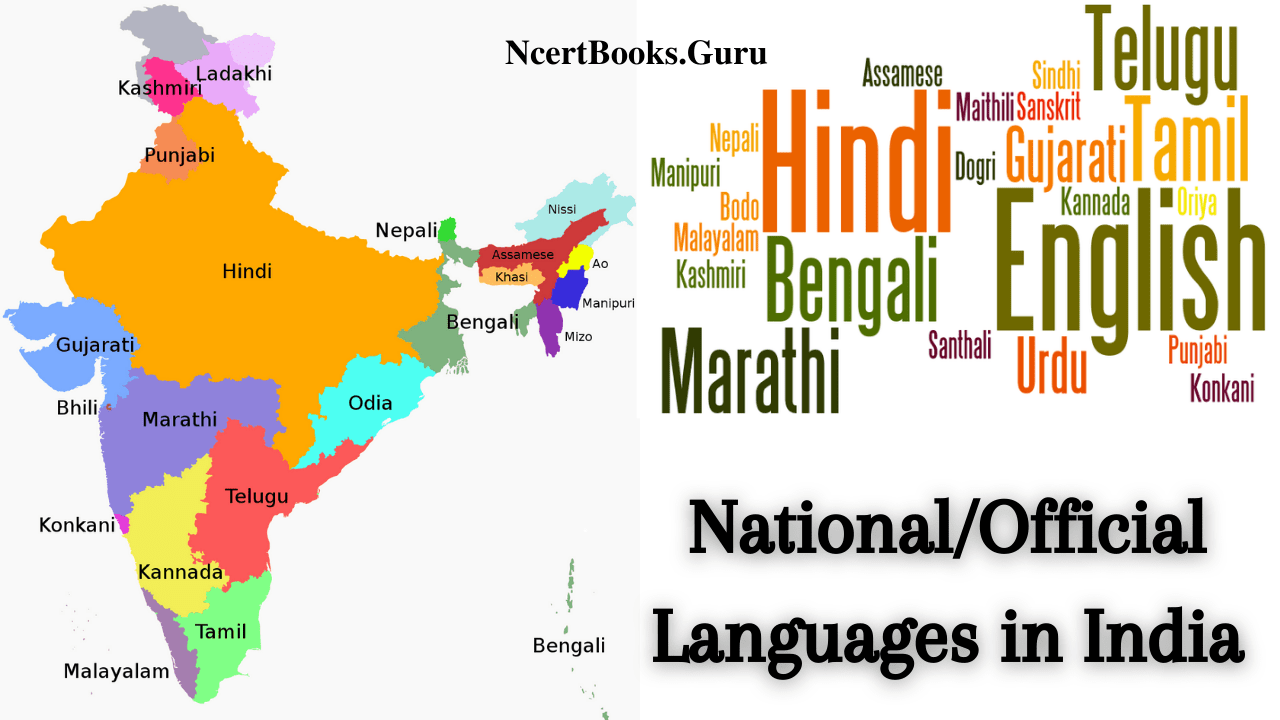
The Indian constitution recognizes 22 official languages, each representing the diverse linguistic heritage of the country. These languages play a crucial role in governance, education, and cultural expression across different regions of India.
Hindi and English
Hindi, written in the Devanagari script, is the most widely spoken language in India and serves as the official language of the Union Government. It is used extensively in northern and central India and is also an associate official language in several other states.
English, a legacy of British colonial rule, remains an important language in India. It is used in higher education, government, and business and serves as an associate official language alongside Hindi at the national level.
Regional Languages
In addition to Hindi and English, each state and union territory in India has its own official language(s). These regional languages reflect the linguistic diversity of the country and play a vital role in local administration, education, and cultural preservation.
- Assamese: Official language of Assam.
- Bengali: Official language of West Bengal, Tripura, and Barak Valley region of Assam.
- Gujarati: Official language of Gujarat and Dadra and Nagar Haveli and Daman and Diu.
- Kannada: Official language of Karnataka.
- Kashmiri: Official language of Jammu and Kashmir.
- Konkani: Official language of Goa.
- Malayalam: Official language of Kerala and Lakshadweep.
- Marathi: Official language of Maharashtra.
- Odia: Official language of Odisha.
- Punjabi: Official language of Punjab and Chandigarh.
- Sanskrit: Official language of Uttarakhand.
- Sindhi: Official language of Sindh province in Pakistan and also recognized in India.
- Tamil: Official language of Tamil Nadu and Puducherry.
- Telugu: Official language of Andhra Pradesh and Telangana.
- Urdu: Official language of Jammu and Kashmir and also recognized in several other states.
Historical and Cultural Significance
The official languages of India reflect the country’s rich linguistic heritage and its diverse cultural landscape. They have played a significant role in shaping the nation’s history, literature, and art. Many of these languages have a long literary tradition and are closely tied to specific cultural and religious practices.
The recognition and promotion of these official languages by the Indian government has helped preserve and revitalize India’s linguistic diversity and has contributed to the country’s cultural identity and unity.
Regional Languages
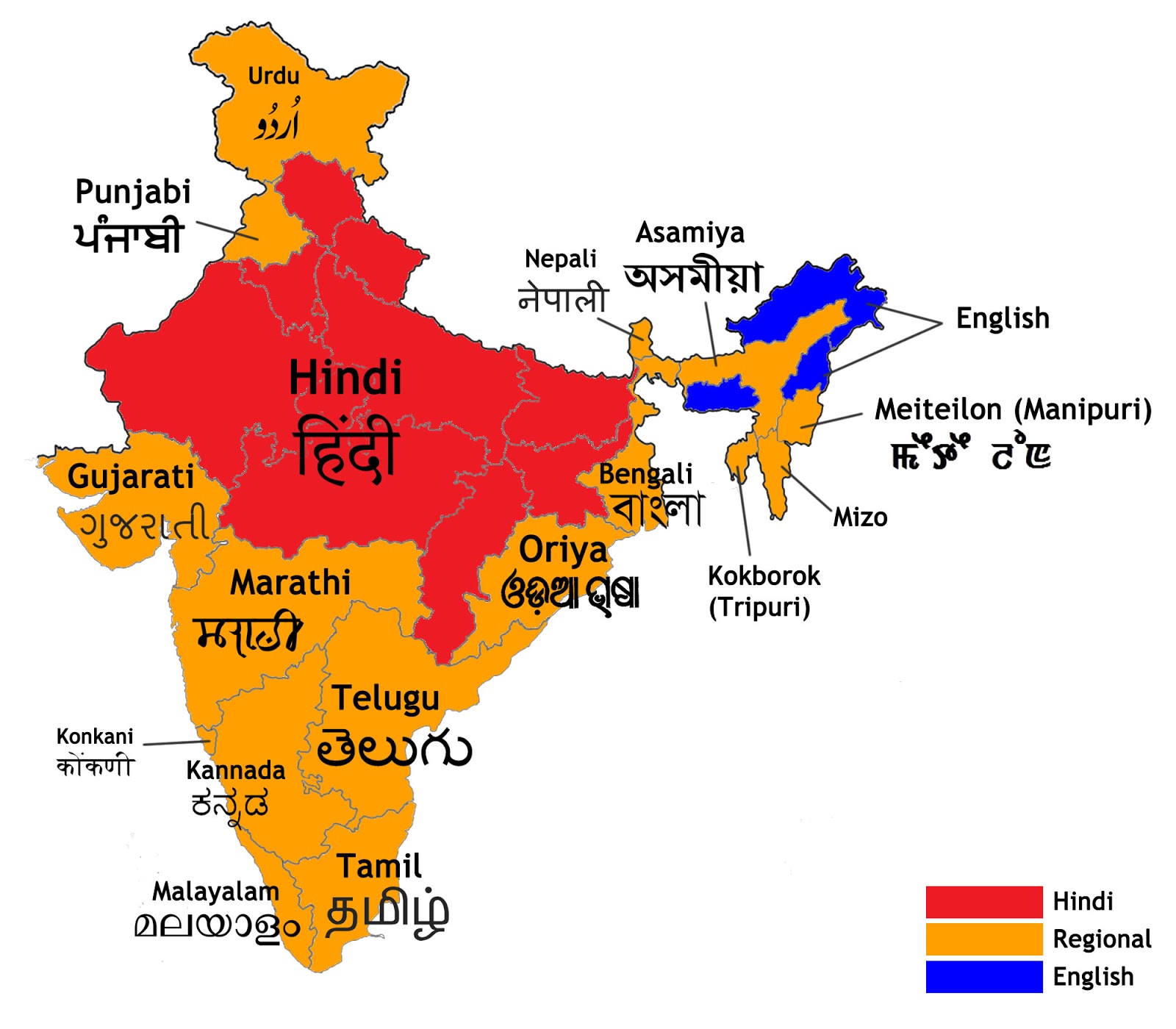
India is a linguistically diverse nation with over 122 major languages and 1599 other languages, including dialects. The Indian constitution recognizes 22 official languages, with Hindi and English serving as the official languages of the union. However, the vast majority of Indians communicate in their regional languages, which play a vital role in shaping the cultural and linguistic landscape of the country.
Geographical Distribution of Regional Languages
Regional languages in India are geographically distributed across various regions, each with its unique linguistic characteristics. The major regional languages include:
- Hindi: Spoken in the northern and central regions, including Uttar Pradesh, Madhya Pradesh, Rajasthan, and Bihar.
- Bengali: Spoken in West Bengal, Tripura, and parts of Assam and Odisha.
- Marathi: Spoken in Maharashtra and parts of Goa and Karnataka.
- Tamil: Spoken in Tamil Nadu and parts of Kerala and Puducherry.
- Kannada: Spoken in Karnataka and parts of Andhra Pradesh and Maharashtra.
- Malayalam: Spoken in Kerala and Lakshadweep.
- Gujarati: Spoken in Gujarat and parts of Rajasthan and Maharashtra.
- Odia: Spoken in Odisha and parts of West Bengal and Andhra Pradesh.
- Punjabi: Spoken in Punjab, Haryana, and parts of Himachal Pradesh and Jammu and Kashmir.
- Assamese: Spoken in Assam and parts of Arunachal Pradesh and Nagaland.
- Kashmiri: Spoken in the Kashmir Valley of Jammu and Kashmir.
li>Telugu: Spoken in Telangana, Andhra Pradesh, and parts of Karnataka and Tamil Nadu.
Minority Languages

India is a linguistically diverse country with over 780 languages and dialects. Apart from the official and regional languages, there are numerous minority languages spoken by various communities across the country. These languages play a vital role in preserving cultural heritage and fostering linguistic diversity.
Number of Minority Languages
The exact number of minority languages in India is not precisely known due to the lack of a clear definition of what constitutes a minority language. However, estimates suggest that there are over 200 minority languages spoken in the country.
Distribution of Minority Languages
Minority languages are distributed throughout India, with some regions having a higher concentration than others. States like Arunachal Pradesh, Mizoram, and Nagaland have a particularly high number of minority languages due to their diverse ethnic populations.
Examples of Minority Languages
- Bodo (Assam)
- Gondi (Central India)
- Kodava (Karnataka)
- Mizo (Mizoram)
- Santhali (Eastern India)
Preservation and Promotion of Minority Languages
Recognizing the importance of minority languages, the Indian government has taken several steps to preserve and promote them. These include:
- Establishing the National Institute of Minority Languages Education (NIMLE) to provide teacher training and develop teaching materials.
- Providing financial assistance to minority language communities for cultural preservation and language development.
- Encouraging the use of minority languages in education and government administration.
Language Families
India is a linguistically diverse country with over 122 major languages and 1599 other languages, each spoken by a significant number of people. These languages belong to different language families, each with its own unique characteristics and distribution.
Indo-Aryan Family
The Indo-Aryan family is the most widely spoken language family in India, with over 70% of the population speaking an Indo-Aryan language. Indo-Aryan languages are descended from Sanskrit, the ancient language of India, and share many common features, including a similar grammatical structure, vocabulary, and sound system.
- Characteristics:Subject-verb-object word order, postpositions, and a rich system of verb tenses.
- Distribution:Spoken throughout India, with the major languages being Hindi, Bengali, Marathi, Gujarati, and Punjabi.
Dravidian Family
The Dravidian family is the second largest language family in India, spoken by about 20% of the population. Dravidian languages are spoken in southern India and are not related to Indo-Aryan languages. They have a unique grammatical structure, vocabulary, and sound system.
- Characteristics:Verb-subject-object word order, suffixes, and a complex system of verb conjugations.
- Distribution:Spoken in southern India, with the major languages being Tamil, Telugu, Kannada, and Malayalam.
Tibeto-Burman Family
The Tibeto-Burman family is spoken by about 5% of the population of India. Tibeto-Burman languages are spoken in the northeastern and Himalayan regions of India and are related to the languages of Tibet and Burma. They have a variety of grammatical structures and sound systems.
In India, a diverse array of languages are spoken, reflecting its rich cultural heritage. The official languages of the country are Hindi and English, with over 22 recognized regional languages spoken throughout the country. Similarly, in Colombia, the official language is Spanish, while indigenous languages and dialects are also spoken by various ethnic groups.
To delve deeper into the linguistic diversity of Colombia, one can refer to the comprehensive article What Language Do Colombian People Speak. Returning to India, the prevalence of numerous languages highlights the country’s linguistic and cultural richness.
- Characteristics:Subject-object-verb word order, prefixes, and a complex system of noun classifiers.
- Distribution:Spoken in the northeastern and Himalayan regions of India, with the major languages being Tibetan, Burmese, and Manipuri.
Austroasiatic Family
The Austroasiatic family is spoken by about 1% of the population of India. Austroasiatic languages are spoken in the eastern and northeastern regions of India and are related to the languages of Southeast Asia. They have a variety of grammatical structures and sound systems.
- Characteristics:Subject-verb-object word order, postpositions, and a complex system of verb tenses.
- Distribution:Spoken in the eastern and northeastern regions of India, with the major languages being Santali, Munda, and Khasi.
Historical and Linguistic Relationships
The language families of India have a long and complex history. The Indo-Aryan languages were brought to India by the Indo-Aryans, who migrated from Central Asia around 1500 BC. The Dravidian languages were spoken in India before the arrival of the Indo-Aryans, and they are thought to have originated in the Indus Valley Civilization.
The Tibeto-Burman languages were brought to India by the Tibeto-Burman peoples, who migrated from Tibet and Burma. The Austroasiatic languages were brought to India by the Austroasiatic peoples, who migrated from Southeast Asia.
The language families of India have influenced each other over time. For example, many Indo-Aryan languages have borrowed words from Dravidian languages, and many Dravidian languages have borrowed words from Indo-Aryan languages.
Implications of Language Diversity for Language Policy and Education
The language diversity of India has implications for language policy and education. The Indian government has adopted a multilingual policy, which recognizes the importance of all the major languages of India. However, the dominance of Hindi and English in education and government has led to concerns about the survival of other languages.
There is a need for a balanced language policy that promotes the use of all the major languages of India while also ensuring that all citizens have access to education in their own language.
Map of India Showing the Distribution of Language Families
[Provide a map of India showing the distribution of language families.]
Endangered Languages
India is a linguistically diverse country with hundreds of languages spoken across the subcontinent. However, many of these languages are facing endangerment due to various factors, including language shift, lack of official recognition, loss of cultural practices, and socioeconomic factors.
Contributing Factors to Language Endangerment
- Language Shift:As dominant languages like Hindi and English gain prominence, smaller languages are often neglected and replaced.
- Lack of Official Recognition:Many endangered languages lack official recognition, which limits their use in education, government, and media.
- Loss of Cultural Practices:The decline of traditional cultural practices associated with endangered languages contributes to their loss.
- Socioeconomic Factors:Economic marginalization and migration can lead to the loss of language skills among younger generations.
Efforts for Language Revitalization
Efforts are being made to revitalize endangered languages in India through various initiatives:
- Language Documentation and Preservation:Documenting endangered languages through recordings, transcriptions, and dictionaries helps preserve their knowledge.
- Language Teaching and Learning Initiatives:Educational programs aim to teach endangered languages to younger generations and promote their use.
- Community-Based Revitalization Projects:Local communities are actively involved in language revitalization efforts, fostering cultural practices and language use.
Successful Language Revitalization Initiatives
- Tulu Language:Revitalization efforts focused on language documentation, community engagement, and the establishment of a Tulu Academy.
- Mishing Language:A community-led initiative established language schools, published books, and promoted cultural events to revitalize the Mishing language.
- Bodo Language:Government support and the creation of a Bodo Autonomous Council have helped revitalize the Bodo language through education and cultural initiatives.
Current Status and Challenges
Despite revitalization efforts, many endangered languages in India continue to face challenges. Lack of resources, limited support, and ongoing language shift pose significant threats. However, ongoing efforts to document, teach, and promote endangered languages offer hope for their preservation and revitalization.
Multilingualism

India is a multilingual country with a rich linguistic diversity. The 2011 census recorded 121 languages spoken as mother tongues in India, belonging to four major language families: Indo-Aryan, Dravidian, Austroasiatic, and Sino-Tibetan. The most widely spoken languages in India are Hindi, Bengali, Telugu, Marathi, and Tamil.Multilingualism in India is influenced by a number of factors, including historical influences, cultural diversity, and economic opportunities.
India’s history of colonization by various empires has left a lasting impact on the country’s linguistic landscape, with many languages borrowing words and phrases from English, Persian, and Arabic. India’s cultural diversity also contributes to multilingualism, as different regions of the country have their own unique languages and dialects.
Additionally, economic opportunities in India have led to increased migration, which has resulted in a greater mixing of languages.
In India, a diverse array of languages are spoken, including Hindi, Bengali, Telugu, and Marathi. These languages belong to different language families and reflect the country’s rich cultural heritage. JavaScript, a scripting language often used in web development, shares similarities with these languages in its dynamic nature.
Just as Hindi and Bengali are used for communication in India, JavaScript enables interactive elements on websites, making it a versatile tool for creating engaging user experiences. By understanding the similarities between JavaScript and the languages spoken in India, developers can leverage the power of both to create multilingual web applications that cater to a diverse audience.
Challenges and Benefits of Multilingualism
Living in a multilingual society in India presents both challenges and benefits. One of the main challenges is the issue of language barriers. With so many different languages spoken in India, it can be difficult for people from different regions to communicate with each other.
This can lead to misunderstandings, discrimination, and social isolation. However, multilingualism also offers a number of benefits. Multilingual individuals have the ability to communicate with a wider range of people, which can lead to increased cultural exchange and understanding. Additionally, multilingualism has been shown to have cognitive benefits, such as improved memory and problem-solving skills.
Personal Experiences of Multilingual Individuals
The personal experiences of multilingual individuals in India are varied. Some multilingual individuals report feeling a sense of pride in their ability to speak multiple languages. They may also feel a sense of connection to different cultures and communities. However, other multilingual individuals may report feeling a sense of alienation or isolation.
They may feel like they do not belong to any one culture or community.
Table: Key Findings on Multilingualism in India
| Key Finding | Description ||—|—|| Number of languages spoken | 121 || Most widely spoken languages | Hindi, Bengali, Telugu, Marathi, Tamil || Factors influencing language choice | Historical influences, cultural diversity, economic opportunities || Challenges of multilingualism | Language barriers, misunderstandings, discrimination, social isolation || Benefits of multilingualism | Increased cultural exchange, understanding, cognitive benefits |
Resources for Further Research
* [Multilingualism in India: A Sociolinguistic Survey](https://books.google.co.in/books?id=U7-fDwAAQBAJ&pg=PA1&lpg=PA1&dq=Multilingualism+in+India:+A+Sociolinguistic+Survey&source=bl&ots=2KdV1Kq39-&sig=ACfU3U2VzlKg0yIE781XaqG9A7n01C0s5Q&hl=en)
[The Languages of India](https
//www.britannica.com/topic/languages-of-India)
[Multilingualism in India
Challenges and Opportunities](https://www.thehindu.com/opinion/op-ed/multilingualism-in-india-challenges-and-opportunities/article29323444.ece)
Language Policy
The Indian government’s language policy aims to promote the use of Hindi as the official language of the country while also recognizing the importance of regional languages and English as an associate official language.
The policy’s objectives include fostering national unity, facilitating communication between different linguistic groups, and preserving the cultural heritage of India.
Implementation and Impact, What languages do people in india speak
The policy has been implemented through various measures, including the establishment of the Central Hindi Directorate, the translation of official documents into Hindi, and the promotion of Hindi in education and the media.
The policy has had a significant impact on language use in India. Hindi has become the dominant language in government and higher education, while regional languages continue to be widely used in everyday life and in lower levels of education.
Controversies and Debates
The language policy has been the subject of controversies and debates, with some groups arguing for a greater role for Hindi and others advocating for the protection of regional languages.
Critics of the policy argue that it has led to the marginalization of regional languages and that it is not in line with the linguistic diversity of India.
Language Education

Language education in India has a rich history, reflecting the country’s diverse linguistic landscape. The system has undergone significant evolution, shaped by factors such as colonial influences, the independence movement, and the post-independence era.
Historical Development
During the British colonial period, English was introduced as the medium of instruction in higher education. After independence, the Indian government adopted a three-language formula, which emphasized the teaching of Hindi, English, and a regional language in schools. This formula aimed to promote national unity while preserving regional linguistic identities.
Current Structure
The current language education system in India is complex and multi-layered. It includes primary, secondary, and higher education levels, with varying language policies and curricula. At the primary level, instruction is typically in the regional language or the mother tongue.
English is introduced as a second language in later grades. Hindi is also taught in many states as a third language.
Challenges
Despite its rich history, language education in India faces several challenges. These include:
- Regional disparities in language access and proficiency
- Socio-economic disparities in language learning opportunities
- Limited availability of qualified language teachers
- Lack of standardized language assessment tools
Language and Culture
Language and culture are deeply intertwined in India. Languages shape cultural identity and are shaped by cultural practices and traditions.The relationship between language and culture is evident in various ways. For example, many Indian languages have specific words and phrases that describe cultural concepts and practices.
These words and phrases cannot be easily translated into other languages, as they are deeply rooted in the specific cultural context.
Cultural Practices and Traditions Tied to Specific Languages
Many cultural practices and traditions in India are closely tied to specific languages. For example, the traditional Indian dance form of Bharatanatyam is performed in Tamil. The lyrics of Bharatanatyam songs are in Tamil, and the dance movements are designed to express the meaning of the lyrics.Similarly, the traditional Indian music form of Carnatic music is performed in Tamil, Telugu, Kannada, and Malayalam.
The lyrics of Carnatic music songs are in these languages, and the music is designed to express the meaning of the lyrics.These are just a few examples of the many ways in which language and culture are intertwined in India.
Language is an essential part of Indian culture, and it plays a vital role in shaping the identity of the Indian people.
Language and Media: What Languages Do People In India Speak
The Indian media landscape is a complex and diverse one, reflecting the country’s linguistic and cultural diversity. Language plays a crucial role in shaping the media content consumed by the Indian population, and different languages are used in print, broadcast, and digital media to cater to the needs of different linguistic groups.
In print media, newspapers and magazines are published in a variety of languages, including Hindi, English, Tamil, Telugu, Marathi, and Bengali. This allows readers to access news and information in their own language, making it more accessible and relevant to them.
Broadcast Media
Broadcast media, such as television and radio, also use a variety of languages to reach different audiences. Hindi is the most widely spoken language in India, and it is the primary language used by national television and radio channels. However, regional channels often use local languages to cater to the specific needs of their viewers.
For example, in the southern Indian state of Tamil Nadu, the majority of television channels broadcast in Tamil. This allows Tamil-speaking viewers to access news, entertainment, and other content in their own language.
Digital Media
Digital media has also played a significant role in shaping the Indian media landscape. The internet and social media platforms have made it possible for people to access news and information from a variety of sources, including both traditional media outlets and independent content creators.
As a result, there has been a growing demand for content in different languages. Many websites and social media pages now offer content in multiple languages to cater to the needs of their diverse audiences.
Impact of Media on Language Use and Attitudes
The media plays a significant role in shaping language use and attitudes. By providing content in different languages, the media helps to promote linguistic diversity and preserve minority languages.
Additionally, the media can influence the way people view and use different languages. For example, the use of Hindi in national television and radio channels has helped to promote the spread of Hindi as a lingua franca in India.
However, the media can also have a negative impact on language use and attitudes. For example, the dominance of English in print and digital media can lead to the marginalization of other languages.
It is important to ensure that the media promotes linguistic diversity and supports the use of all languages, including minority languages. This can help to create a more inclusive and equitable media landscape that reflects the linguistic and cultural diversity of India.
Language and Technology
Technology has had a profound impact on language use in India. The proliferation of social media, messaging apps, and other technologies has led to new ways of communicating and sharing information. These technologies have also played a role in shaping language practices, including the use of new words and phrases, and the adoption of new communication styles.
Social Media and Messaging Apps
Social media platforms like Facebook, Twitter, and Instagram have become major platforms for communication in India. These platforms allow users to share text, images, and videos with their friends and followers. They have also become a space for political discourse, social activism, and cultural exchange.
Messaging apps like WhatsApp and Telegram have also become popular in India. These apps allow users to send text messages, make voice and video calls, and share files. They have become a convenient way for people to stay connected with friends and family, and have also been used for business and political purposes.
Language Preservation and Revitalization
Technology can also be used to support language preservation and revitalization efforts. For example, digital archives can be used to store and preserve endangered languages. Online language learning platforms can be used to teach minority languages to new speakers. And social media can be used to connect speakers of endangered languages and to promote their use.
Challenges and Opportunities
While technology has many benefits for language use in India, it also presents some challenges. One challenge is the spread of misinformation and hate speech online. Another challenge is the potential for technology to lead to language loss, as people increasingly use English and other major languages for communication.
Despite these challenges, technology also presents many opportunities for language use in India. By harnessing the power of technology, we can support language preservation and revitalization efforts, and promote the use of all languages in India.
Language and Identity
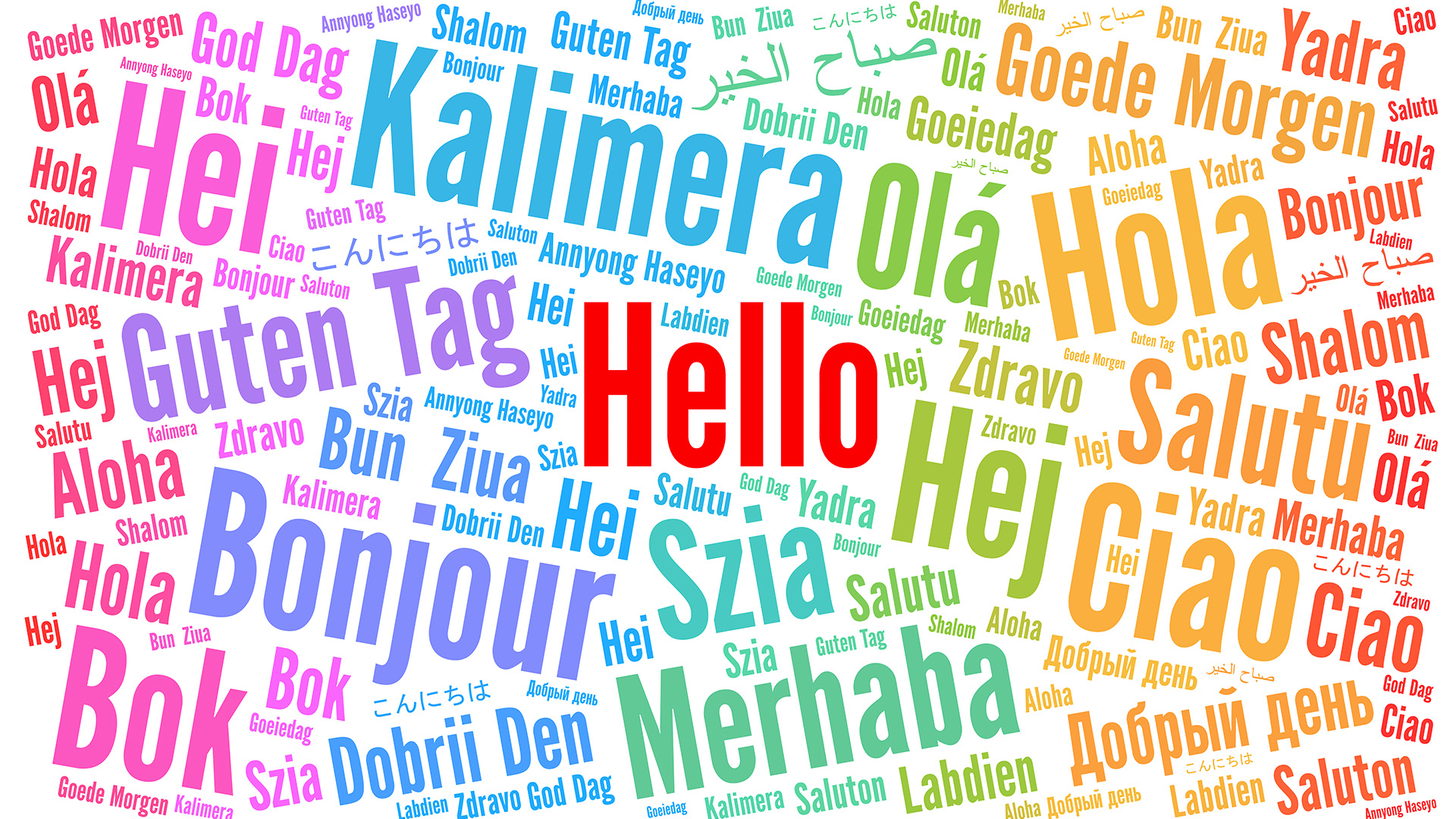
In India, language plays a pivotal role in shaping individual and collective identities. It serves as a potent force that fosters a sense of belonging, pride, and empowerment. However, it can also become a source of challenges and conflicts when it becomes a marker of identity.
Language as a Source of Pride and Belonging
Language is closely intertwined with cultural heritage and tradition in India. Each language carries unique nuances, idioms, and expressions that reflect the experiences and perspectives of its speakers. Speaking a particular language connects individuals to a shared history, cultural practices, and values.
It fosters a sense of belonging and pride, reinforcing a strong attachment to one’s linguistic community.
Language as a Source of Empowerment
Language can be a powerful tool for empowerment, particularly for marginalized communities. When individuals have access to education and opportunities in their own language, they gain the confidence and ability to participate fully in society. Language empowers them to express their thoughts, ideas, and aspirations, fostering a sense of self-worth and agency.
Challenges and Conflicts Related to Language and Identity
While language can be a unifying force, it can also become a source of division and conflict when it becomes a marker of identity. In multilingual societies like India, linguistic diversity can sometimes lead to tensions and misunderstandings. Individuals may face discrimination or prejudice based on their language, which can hinder their social and economic opportunities.
Moreover, when language becomes closely associated with political or religious identities, it can exacerbate existing social divisions. Language can be used to promote exclusionary ideologies, marginalize certain groups, and perpetuate stereotypes. This can lead to conflicts and hinder efforts to build a harmonious and inclusive society.
Language and Society

Language plays a crucial role in shaping social stratification and maintaining social hierarchies in India. It is a powerful tool that can be used to perpetuate inequality and marginalize certain groups.
Language-based Discrimination in India
Historically, language has been used to discriminate against certain groups in India. For example, the caste system has been reinforced through the use of language, with higher castes often speaking different languages or dialects than lower castes. This has led to social and economic disparities, with lower castes facing discrimination in education, employment, and other areas.
Government Policies and Language Inequality
Government policies have also played a role in promoting or perpetuating language inequality. For example, the imposition of Hindi as the national language in 1950 led to protests in non-Hindi speaking states. This policy has been criticized for marginalizing regional languages and cultures.
Efforts to Promote Language Equality
In recent years, there have been efforts to promote language equality and social justice in India. These efforts include the recognition of regional languages in the constitution, the establishment of language commissions, and the promotion of multilingualism in education.
Evaluating the Effectiveness of Language Equality Efforts
The effectiveness of efforts to promote language equality in India is a matter of debate. While some progress has been made, there is still a long way to go. Language-based discrimination continues to exist in many areas, and there is a need for further efforts to address this issue.
Policy Recommendations
To further promote language equality and social justice in India, several policy recommendations can be made. These include:
- Strengthening the implementation of existing language policies
- Promoting multilingualism in education and government
- Providing support for endangered languages
- Raising awareness about the importance of language equality
By implementing these recommendations, India can take significant steps towards creating a more just and equitable society for all its citizens.
– Discuss the challenges and opportunities facing languages in India in the 21st century.

The 21st century has brought forth both challenges and opportunities for languages in India. With globalization, technology, and migration shaping the world, the landscape of language use is undergoing significant transformations.
What are the specific challenges facing languages in India?
- Language Loss and Extinction:India is home to a vast number of languages, many of which are spoken by small communities. As these communities become increasingly integrated into the mainstream, their languages face the risk of decline and eventual extinction.
- Standardization and Dominance:The dominance of certain languages, such as Hindi and English, in education, media, and government, can lead to the marginalization of other languages.
- Socioeconomic Factors:Economic disparities and social inequalities can contribute to language loss, as speakers from disadvantaged backgrounds may face pressure to adopt more dominant languages.
What are the potential opportunities for languages in India?
- Preservation and Revitalization:Growing awareness of the importance of language diversity has led to efforts to preserve and revitalize endangered languages.
- Multilingualism and Cultural Heritage:India’s multilingualism is a valuable asset that can foster cultural understanding and preserve the nation’s rich linguistic heritage.
- Economic Benefits:Preserving and promoting indigenous languages can contribute to economic development by supporting local industries and tourism.
Frequently Asked Questions
What is the most widely spoken language in India?
Hindi is the most widely spoken language in India, with over 500 million native speakers.
How many official languages are there in India?
India has 22 official languages, including Hindi, English, and various regional languages.
What is the significance of regional languages in India?
Regional languages play a vital role in preserving cultural heritage, promoting linguistic diversity, and fostering a sense of identity within different regions of India.
What are some of the challenges facing endangered languages in India?
Endangered languages in India face challenges such as language shift, lack of official recognition, and loss of cultural practices.
What is the role of technology in language preservation and revitalization in India?
Technology can play a significant role in language preservation and revitalization through documentation, language learning apps, and community-based projects.
