American Sign Language (ASL) is a beautiful, expressive, and fully realized visual language. For beginners, learning everyday vocabulary is one of the most practical ways to start communicating. One of these essential daily signs is the word for “shower,” which is useful for discussing morning routines, hygiene, and daily schedules.
Learning how to express “shower in sign language” involves understanding the physical mechanics of the sign and the context in which it is used. In this guide, we will break down the sign for shower, explore basic ASL grammar, and look at essential beginner vocabulary. We will also discuss the cultural etiquette that keeps conversations respectful and meaningful within the Deaf community.
Introduction to ASL & Deaf Culture
American Sign Language is a complete, natural language that serves as the primary language for many Deaf individuals in North America. It is not a simplified version of English, nor is it pantomime. Instead, ASL possesses its own complex grammatical rules, syntax, and historical roots that date back over two centuries.
To truly appreciate ASL, one must also appreciate Deaf culture. The Deaf community does not view deafness as a disability or a medical deficit to be cured. Rather, it is embraced as a unique cultural identity, complete with its own shared history, social norms, and artistic expressions.
When you begin to learn signs like the sign for a shower, you are taking your first steps into a vibrant linguistic world. Understanding the cultural context of these signs will help you communicate more authentically. It also shows the community that you respect their language as a distinct and valuable way of experiencing the world.

Linguistic accessibility is at the heart of Deaf culture. By learning how to sign daily routines, you can connect with Deaf friends, family members, or colleagues on a deeper level. Let us explore how ASL differs from English systems to give you a solid foundation for your learning journey.
Key Differences: ASL vs. Signed English
A common misconception among beginners is that sign language is simply English words spelled out or signed in English word order. In reality, ASL has a unique structure that is completely independent of English grammar. While English relies on vocal tone and word order, ASL utilizes spatial relationships, facial expressions, and body movements.
Signed English systems, such as Signing Exact English (SEE), were created by educators to mirror English grammar word-for-word. SEE uses English syntax and often adds prefixes and suffixes to signs. Deaf individuals often appreciate when hearing learners recognize that sign language is a complete linguistic system rather than a code for English.
ASL, on the other hand, is conceptual and topic-comment based. For example, in English, you might say, “I am going to take a shower.” In ASL, you do not sign every single word in that English sentence; instead, you establish the time and topic first, signing something closer to “Future shower me.”
This conceptual nature means that signs represent ideas rather than specific English words. When you learn to sign “shower,” you are signing the concept of water spraying down from above. This makes the language highly visual, efficient, and expressive.
Essential Beginner Signs
Now that you understand the foundation of ASL, let us focus on how to sign “shower in sign language” and other essential vocabulary. Learning these signs requires attention to handshape, location, movement, and orientation. Practicing these four parameters will ensure your signs are clear and easily understood by others.
To perform the sign for shower, start by raising your dominant hand slightly above and to the side of your head. Form a loose, closed handshape, similar to a relaxed fist or a flattened “O” handshape, with your palm facing down or toward your head. From this position, repeatedly open and close your fingers into a flared “5” handshape, mimicking the spraying action of water from a shower head. This quick opening and closing motion is typically repeated two or three times.
It is important to keep your hand positioned above your head to clearly distinguish it from other signs. If you perform a similar opening and closing motion near your face or chest, it could be confused with signs like “light” or “flower.” Keeping the hand high ensures the concept of overhead water is immediately clear to the person watching you.
Greetings & Common Phrases
Building a basic vocabulary allows you to start simple conversations. If you want to introduce yourself, learning how to sign my name is in sign language is an excellent starting point. This phrase combines the signs for “my,” “name,” and your fingerspelled name to introduce yourself clearly.
When asking what someone is planning to do, you can use the sign for do in sign language to keep the conversation flowing. This sign is made by bringing both hands in front of you with palms facing up, forming “G” handshapes, and tapping your index fingers and thumbs together repeatedly. It is a highly versatile sign used in many everyday questions.
Other essential greetings include “hello,” which is signed like a polite salute from your forehead. To sign “thank you,” touch the fingertips of your flat dominant hand to your lips and move your hand downward and forward toward the person you are speaking to. These simple gestures lay the groundwork for polite, friendly interactions.
Fingerspelling & Numbers
Fingerspelling is the practice of spelling out words letter-by-letter using the ASL manual alphabet. It is used for proper nouns, names, titles, and words that do not have a specific sign. When you are unsure of a sign, fingerspelling is a reliable backup method to communicate your message.
When fingerspelling, keep your elbow relaxed near your body and hold your hand steady at shoulder height. Avoid bouncing your hand with each letter, as this makes it difficult for others to read. Instead, focus on smooth transitions from one letter shape to the next, keeping your palm facing the viewer.
After a long day, you might want to sign about going to sleep in sign language to indicate you are tired. The sign for sleep is made by bringing your dominant hand over your face, fingers spread, and pulling your hand down past your chin while closing your fingers to touch your thumb. As you do this, let your eyes close slightly to convey the feeling of fatigue.
Importance of Non-Manual Markers
In ASL, your hands are only part of the equation. Non-manual markers (NMMs) include facial expressions, head tilts, eye gaze, and body movements. These markers serve as the grammar and tone of voice in signed conversations, transforming simple vocabulary into complex statements.
For example, a furrowed brow can turn a statement into a question, while raised eyebrows can indicate a conditional clause or a yes/no question. Without NMMs, signing would look flat and emotionless, much like speaking in a monotone voice. Your face tells the listener how to interpret the physical signs your hands are making.
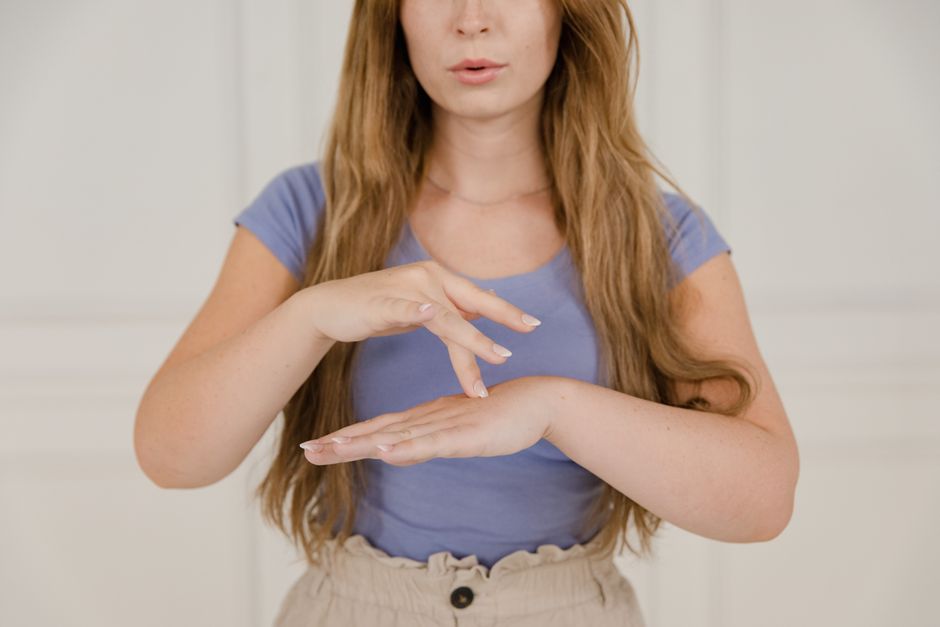
If you are signing about a cold shower, your facial expression should reflect that cold sensation with widened eyes or a slight shiver. Conversely, if you are describing a warm, relaxing shower, your face should look relaxed and peaceful. This visual layer of information adds depth and clarity to your communication, making it much more engaging.
Practicing non-manual markers can feel unnatural at first for hearing learners who are used to expressing tone vocally. However, with time and practice, you will find that integrating your facial expressions with your hand movements becomes second nature. It is this integration that brings the beauty of ASL to life.
Deaf Community Etiquette & Myths
When interacting with the Deaf community, understanding cultural etiquette is just as important as knowing the signs. One of the most critical rules of etiquette is maintaining eye contact. In Deaf culture, looking away during a conversation is considered impolite, as it is the equivalent of covering your ears while someone is speaking to you.
Another important aspect of etiquette is knowing how to get someone’s attention respectfully. You can gently tap a person on the shoulder, or wave your hand slightly in their line of sight. Never wave aggressively close to their face, and avoid tapping too hard, as this can be perceived as rude.
Understanding sensitive concepts, such as how to sign die in sign language, is also crucial for meaningful, respectful communication. This sign is performed by holding both flat hands in front of you, one palm up and one palm down, and then rolling them over so their orientations reverse. Using correct, respectful signs for serious topics shows maturity and respect for the language.
There are also several myths surrounding ASL that need to be dispelled. For instance, many people incorrectly believe that sign language is universal. In fact, there are hundreds of different sign languages used around the world, such as British Sign Language (BSL) and French Sign Language (LSF), which are completely distinct from ASL.
Another myth is that lip-reading is an easy alternative to sign language. In reality, lip-reading is highly exhausting and only about 30 to 40 percent of English speech sounds can be clearly identified on the lips. Learning to sign is a far more reliable and respectful way to ensure clear communication with Deaf individuals.
Frequently Asked Questions
How do you sign “shower” in American Sign Language?
To sign “shower,” hold your dominant hand above your head with your palm facing down or toward your head. Open and close your fingers repeatedly into a flared “5” handshape, mimicking the spraying action of water. Repeat this motion two or three times.
Is the sign for shower the same as the sign for rain?
No, they are different. While both involve downward water concepts, the sign for “rain” uses both hands starting at head level and moving downward in a gentle, clawed handshape. The sign for “shower” is typically done with one dominant hand held stationary above the head while the fingers open and close.
Can I teach my baby the sign for shower?
Yes, “shower” is a great sign to teach babies during their bath time routine. Baby sign language helps infants communicate their needs before they can speak vocally, reducing frustration for both parents and children.
Why is eye contact so important in ASL?
In ASL, eye contact is essential because facial expressions and eye gaze carry grammatical meaning. Looking away during a conversation can interrupt the flow of communication and is often considered disrespectful in Deaf culture.
Is ASL used worldwide?
No, ASL is primarily used in the United States and Canada. Other countries have their own unique sign languages, such as Mexican Sign Language (LSM) or Australian Sign Language (Auslan), which have different vocabularies and structures.
Conclusion
Learning how to sign “shower in sign language” is a wonderful stepping stone into the world of American Sign Language. By mastering the physical handshapes, understanding the role of facial expressions, and respecting Deaf culture, you are building a bridge for meaningful communication. Remember that consistency and respect are key to becoming proficient in this beautiful language.
This written guide is for educational purposes. ASL is a visual language; readers are strongly encouraged to supplement this guide with video resources and classes taught by Deaf instructors.
