Is math the universal language? This question has sparked debates and discussions for centuries. In this academic presentation, we will delve into the concept of math as a language, exploring its universality, applications, and limitations. We will examine the historical, cultural, and philosophical implications of math as a means of communication, uncovering its profound impact on our understanding of the world around us.
Throughout history, math has played a pivotal role in scientific discoveries, technological advancements, and everyday problem-solving. From the calculations of ancient astronomers to the complex equations that govern modern physics, math has provided a common language for scientists, engineers, and mathematicians to share ideas and collaborate on groundbreaking innovations.
Math as a Language
Mathematics is a language that uses symbols, numbers, and equations to communicate complex ideas and concepts. It is a powerful tool that can be used to describe the world around us, from the motion of planets to the behavior of atoms.
While math and spoken languages have some similarities, they also have some important differences.
One of the most important similarities between math and spoken languages is that both are used to communicate ideas. In spoken languages, we use words to express our thoughts and ideas. In math, we use symbols, numbers, and equations to express our thoughts and ideas.
Similarities
Both math and spoken languages have a grammar that governs how symbols and words are combined to form meaningful expressions. For example, in spoken languages, we have rules about how words can be combined to form sentences. In math, we have rules about how symbols and numbers can be combined to form equations.
Another similarity between math and spoken languages is that both are used to convey complex ideas and concepts. In spoken languages, we can use words to describe complex ideas and concepts, such as love, beauty, and justice. In math, we can use symbols, numbers, and equations to describe complex ideas and concepts, such as the motion of planets, the behavior of atoms, and the structure of the universe.
Differences
One of the most important differences between math and spoken languages is that math is a formal language, while spoken languages are natural languages. This means that math has a precise and unambiguous grammar, while spoken languages have a more flexible and ambiguous grammar.
Another important difference between math and spoken languages is that math is a universal language, while spoken languages are not. This means that math can be understood by anyone, regardless of their culture or native language. Spoken languages, on the other hand, can only be understood by people who speak that language.
Universality of Math
Mathematics is often referred to as the universal language, transcending cultural and linguistic barriers to convey complex ideas and concepts. Its universality stems from its inherent logical structure and the fundamental principles that govern it.
Throughout history, math has played a pivotal role in the advancement of civilizations. From the ancient Egyptians and Babylonians to the Greeks and Indians, mathematical discoveries have had a profound impact on our understanding of the world. The development of geometry, algebra, and calculus laid the groundwork for scientific and technological advancements that have shaped human history.
Math in Scientific and Technological Advancements
Math is the cornerstone of modern science and technology. It provides the framework for understanding the laws of nature, from the motion of celestial bodies to the behavior of subatomic particles. Mathematical models and simulations have enabled scientists to make groundbreaking discoveries and develop innovative technologies that have transformed our lives.
- Isaac Newton’s laws of motion, formulated using calculus, revolutionized our understanding of mechanics and paved the way for the development of modern physics.
- The invention of the computer, based on the principles of Boolean algebra, has had an immeasurable impact on every aspect of society, from communication to healthcare.
Math in Art, Music, and Architecture
Beyond its role in science and technology, math also finds applications in the realm of art, music, and architecture. The principles of symmetry, proportion, and harmony are fundamental to creating visually pleasing and aesthetically appealing works of art.
- In music, mathematical ratios determine the intervals and scales that form the basis of melodies and harmonies.
- In architecture, mathematical calculations ensure the structural integrity and aesthetic balance of buildings, from ancient temples to modern skyscrapers.
Mathematical Symbols and Notation
Mathematical symbols and notation play a pivotal role in expressing complex mathematical ideas and concepts in a concise and efficient manner. They serve as a universal language, enabling mathematicians to communicate their ideas across different cultures and time periods.
The evolution of mathematical notation has been a continuous process, with new symbols and conventions being introduced to meet the demands of increasingly complex mathematical theories. This evolution has had a profound impact on the communication of mathematical ideas, making it possible to express complex concepts in a clear and unambiguous way.
Examples of Mathematical Symbols and Notation
- The symbol “=” is used to denote equality, indicating that two mathematical expressions have the same value.
- The symbol “>” is used to denote greater than, indicating that one mathematical expression is greater than another.
- The symbol “∫” is used to denote the integral of a function, indicating the area under the curve of the function.
- The symbol “∑” is used to denote the sum of a series of terms, indicating the total value of the series.
- The symbol “∞” is used to denote infinity, indicating that a mathematical expression approaches a limit without ever reaching it.
Math in Different Cultures

Mathematics is often regarded as a universal language, transcending cultural and linguistic boundaries. However, different cultures have developed their own unique mathematical systems, reflecting their cultural values, beliefs, and experiences.
Similarities and Differences in Mathematical Systems
Despite their differences, mathematical systems across cultures share certain fundamental similarities. These include:
- The use of numbers and symbols to represent quantities and concepts
- The application of logical reasoning and problem-solving techniques
- The development of mathematical theorems and proofs
However, there are also significant differences between mathematical systems. For example, some cultures use a base-10 number system, while others use a base-20 or base-60 system. Some cultures have developed complex systems of geometry and algebra, while others have focused on practical applications of mathematics, such as measurement and accounting.
Influence of Cultural Factors on Mathematics
The development of mathematics in different cultures has been influenced by a variety of factors, including:
- Cultural values:Cultures that value precision and logical reasoning tend to develop more advanced mathematical systems.
- Economic needs:Cultures with complex economies and trade networks need to develop mathematical systems for managing resources and calculating profits.
- Technological advancements:The development of new technologies, such as writing and printing, has facilitated the spread of mathematical knowledge.
Examples of Cultural Influences on Mathematics
Cultural values and beliefs can have a profound impact on the development of mathematical concepts and practices. For example:
- The ancient Greeksbelieved in the power of reason and logic, which led to the development of Euclidean geometry and other advanced mathematical theories.
- The ancient Egyptiansdeveloped a sophisticated system of mathematics for practical purposes, such as measuring land and calculating taxes.
- The Mayansdeveloped a base-20 number system and a system of hieroglyphics for recording mathematical calculations.
Impact of Cross-Cultural Exchange on Mathematics
Cross-cultural exchange has played a significant role in the development of mathematics. For example:
- The transmission of Indian mathematics to the Islamic worldled to the development of algebra and trigonometry.
- The introduction of Arabic numerals to Europesimplified mathematical calculations and led to the development of new mathematical theories.
- The exchange of mathematical ideas between Europe and Chinaduring the Renaissance led to the development of new mathematical techniques and instruments.
Summary
Different cultures have developed their own unique mathematical systems, reflecting their cultural values, beliefs, and experiences. While there are some fundamental similarities between these systems, there are also significant differences. The development of mathematics in different cultures has been influenced by a variety of factors, including cultural values, economic needs, and technological advancements.
Cross-cultural exchange has played a significant role in the development of mathematics, leading to the transmission of mathematical ideas and the development of new mathematical theories and techniques.
Math in Education
Mathematics plays a pivotal role in education, fostering critical thinking and problem-solving skills. Its cognitive benefits extend to improved spatial reasoning, logical thinking, and memory. Innovative teaching approaches, such as technology-based methods, hands-on activities, and inquiry-based learning, enhance student engagement and understanding.
By incorporating real-world examples, making math relevant to student interests, and promoting collaboration, educators can cultivate a positive and effective learning environment.
Cognitive Benefits of Math Education
Improved spatial reasoning
Math exercises involving geometry, visualization, and spatial relationships strengthen students’ ability to understand and manipulate spatial information.
Enhanced logical thinking
Math teaches students to analyze, reason, and draw logical conclusions, developing their ability to think critically and solve problems systematically.
Sharpened memory
The process of learning and applying mathematical concepts strengthens memory skills, improving students’ ability to recall and retain information.
Innovative Approaches to Teaching Math
Technology-based methods
Interactive software, simulations, and online platforms provide engaging and personalized learning experiences, allowing students to explore mathematical concepts at their own pace.
Hands-on activities
Practical experiments and hands-on projects make math tangible and relatable, fostering a deeper understanding of abstract concepts.
Inquiry-based learning
By posing questions and guiding students through the process of discovery, inquiry-based learning encourages critical thinking and problem-solving.
Strategies for Engaging Students in Math Learning
Real-world examples
Connecting math to real-life situations makes it more relevant and meaningful for students.
Student interests
Incorporating students’ interests into math lessons can increase their motivation and engagement.
Collaboration and peer learning
Group projects and peer discussions provide opportunities for students to share knowledge, learn from each other, and develop social skills.
Successful Math Education Programs
Singapore Math
A highly effective math curriculum known for its emphasis on problem-solving and critical thinking.
Khan Academy
A non-profit organization providing free online math education to students worldwide.
Project-Based Learning (PBL)
An approach that involves students in real-world projects, fostering collaboration, problem-solving, and critical thinking.
Call to Action
Educators must prioritize math education and invest in innovative teaching methods to equip students with the essential skills and knowledge they need to succeed in an increasingly complex world. By fostering a positive and engaging learning environment, we can empower students to embrace math and unlock its transformative potential.
Math in Science and Technology
Mathematics serves as a universal language in science and technology, providing a precise and concise means of describing the natural world and technological advancements. Its fundamental role lies in quantifying, modeling, and analyzing complex phenomena, enabling us to understand and predict the behavior of the universe and create innovative technologies.
Applications of Math in Scientific Discoveries and Technological Advancements
Math plays a crucial role in scientific discoveries and technological advancements. For instance, in physics, Newton’s laws of motion and Einstein’s theory of relativity rely heavily on mathematical equations to describe the movement and interactions of objects. In chemistry, the periodic table and chemical equations help us understand the behavior and properties of elements and compounds.
In biology, mathematical models are used to simulate and analyze complex biological systems, such as ecosystems and gene expression.
Impact of Math on Our Understanding of the Universe
Math has significantly impacted our understanding of the universe. The Pythagorean theorem, for example, has been used for centuries to calculate distances and solve geometric problems. Calculus, developed by Newton and Leibniz, is essential for understanding the motion of objects and the rate of change in various physical phenomena.
Statistics and probability theory enable us to analyze data, make predictions, and quantify uncertainty.
Table: Math in Science and Technology
| Field | Mathematical Concepts | Applications |
|---|---|---|
| Physics | Calculus, differential equations, linear algebra | Describing motion, forces, and energy |
| Chemistry | Algebra, stoichiometry, quantum mechanics | Understanding chemical reactions, properties of substances |
| Biology | Statistics, probability, modeling | Analyzing biological data, simulating complex systems |
| Engineering | Calculus, geometry, differential equations | Designing structures, analyzing stresses, optimizing processes |
| Computer Science | Discrete mathematics, algorithms, data structures | Developing software, designing networks, processing data |
Key Mathematical Concepts in Science and Technology
- Calculus: Differential and integral calculus are essential for understanding change and motion.
- Linear Algebra: Matrices and vectors are used to represent and manipulate systems of equations and geometric transformations.
- Statistics: Probability distributions, sampling, and hypothesis testing are crucial for analyzing data and making predictions.
- Differential Equations: These equations describe the rate of change of a system and are used in modeling a wide range of phenomena.
- Discrete Mathematics: Set theory, graph theory, and combinatorics are used in computer science, optimization, and cryptography.
Math in the Development of New Technologies
Math has played a significant role in the development of new technologies. For instance, the mathematical theory of information laid the foundation for the development of computers and communication networks. In recent years, mathematical concepts such as machine learning and quantum computing have driven advancements in artificial intelligence and quantum technologies.
Math in Everyday Life

Mathematics plays a crucial role in our daily lives, extending far beyond the classroom and into a myriad of practical applications. From making informed decisions to solving problems and understanding the world around us, math empowers us with essential tools for navigating our daily routines.
Math provides a framework for logical reasoning and problem-solving, enabling us to make sense of complex situations and arrive at informed conclusions. It helps us analyze data, draw inferences, and make predictions based on patterns and trends.
Applications in Various Fields
The applications of math are vast and diverse, spanning a wide range of fields:
- Finance:Math is essential for managing personal finances, calculating interest rates, and making informed investment decisions.
- Health:Math plays a vital role in medical research, drug development, and the analysis of medical data to improve patient outcomes.
- Engineering:Math is the foundation for designing and constructing everything from bridges and buildings to airplanes and spacecraft.
- Technology:Math is the driving force behind computer science, artificial intelligence, and the development of new technologies.
- Science:Math is indispensable for scientific research, modeling natural phenomena, and testing hypotheses.
Limitations of Math as a Universal Language
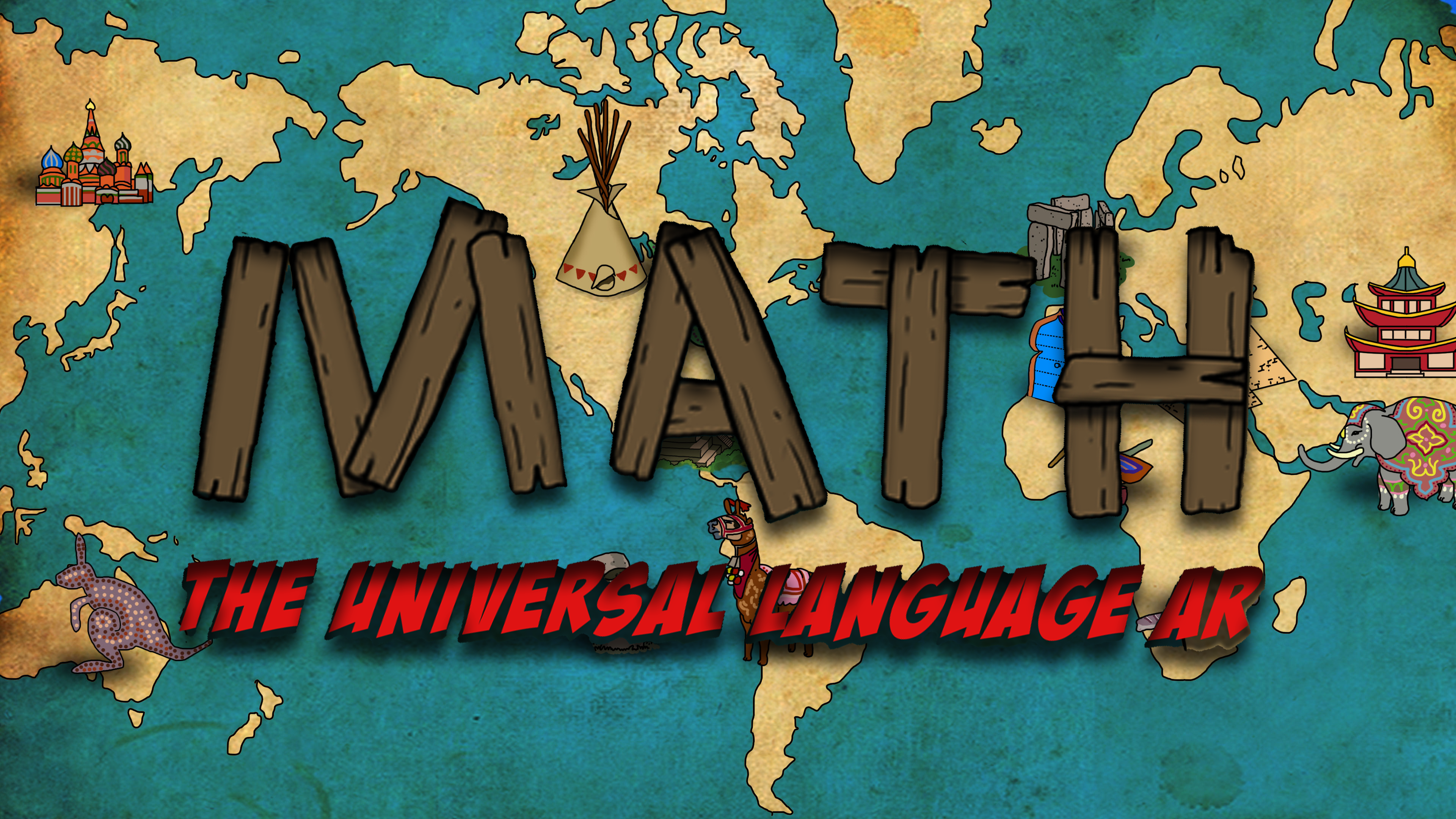
While math possesses remarkable universality, it does have certain limitations in its capacity to express all concepts and ideas. There are situations where math falls short as a sufficient or appropriate means of communication.
Subjectivity and Emotion
Math is inherently objective and logical, making it ill-suited for conveying subjective experiences, emotions, or personal perspectives. For instance, describing the beauty of a sunset or the joy of a reunion cannot be adequately captured through mathematical equations.
Cultural and Contextual Differences, Is math the universal language
Mathematical symbols and notations, though widely recognized, can have different meanings or interpretations across cultures. This can lead to misunderstandings or misinterpretations when communicating complex ideas across cultural boundaries.
Alternative Forms of Communication
When math proves inadequate for expressing certain concepts, alternative forms of communication become necessary. These may include natural language, art, music, or storytelling, which offer unique ways to convey complex ideas that defy mathematical representation.
Math and Philosophy
Math is not just a tool for solving problems; it’s also a language that can be used to express complex ideas about the world around us. As a universal language, math has philosophical implications that have been explored by thinkers for centuries.One of the most important philosophical implications of math is that it can be used to understand the nature of logic and truth.
Math is a formal system, which means that it is based on a set of axioms and rules that can be used to derive new truths. This makes math a powerful tool for reasoning and argumentation, and it has been used to make significant advances in our understanding of the world.Math also plays an important role in our understanding of the nature of reality.
Many philosophers believe that math is a fundamental aspect of the universe, and that it can be used to describe the underlying structure of reality. This view is supported by the fact that math has been used to make successful predictions about the physical world, and that it is often used to describe the laws of nature.
Math and the Nature of Reality
Math is often used to describe the laws of nature, and many physicists believe that math is a fundamental aspect of the universe. This view is supported by the fact that math has been used to make successful predictions about the physical world, such as the existence of gravitational waves.
Math and the Mind
Math is a powerful tool for reasoning and argumentation, and it has been used to make significant advances in our understanding of the world. This suggests that math is not just a language for describing the physical world, but also a language for describing the mind.
Math and Art: Is Math The Universal Language
Mathematics and art have a long and intertwined history, with each influencing the other in various ways. Math provides a framework for understanding the world around us, while art offers a creative expression of that understanding.
Math can inspire artistic expression and creativity in many ways. For example, the golden ratio, a specific proportion found in nature and art, has been used by artists for centuries to create visually pleasing compositions. Fractals, mathematical objects with self-similar patterns, have also been used to create stunning works of art.
The question of whether mathematics is the universal language is a complex one. While mathematics is a powerful tool that can be used to communicate complex ideas across cultures, it is not always clear whether or not it is truly universal.
For example, the language used to express mathematical concepts in Azerbaijan may be different from the language used in other countries. This suggests that mathematics may not be as universal as some believe.
Ways Math Can Be Used in Art
- Creating geometric patterns and designs
- Representing objects and scenes in perspective
- Exploring symmetry and asymmetry
- Using mathematical principles to create optical illusions
- Developing computer-generated art
Relationship Between Math and Art
The relationship between math and art is complex and multifaceted. On one hand, math can be used to analyze and understand art. For example, mathematicians have developed formulas to describe the proportions of the human body, the laws of perspective, and the principles of color theory.
On the other hand, art can also be used to explore mathematical concepts. For example, artists have created works of art that illustrate mathematical theorems, such as the Pythagorean theorem and the Fibonacci sequence.
Lesson Plan on Math and Art
This lesson plan is designed to teach students about the connections between math and art. Students will learn about the golden ratio, fractals, and other mathematical concepts that have been used in art for centuries.
Objectives:
- Students will be able to identify the golden ratio in art.
- Students will be able to create their own fractal art.
- Students will be able to explain the relationship between math and art.
Materials:
- Paper
- Pencils
- Rulers
- Computers with fractal software
Procedure:
- Begin by reviewing the concept of the golden ratio with students. Show them examples of the golden ratio in art, such as the Mona Lisa and the Parthenon.
- Have students create their own golden ratio rectangles. They can do this by dividing a rectangle into two parts, with the ratio of the longer side to the shorter side being 1.618.
- Next, introduce students to fractals. Show them examples of fractal art, such as the Mandelbrot set and the Sierpinski triangle.
- Have students create their own fractal art using fractal software. They can experiment with different parameters to create different types of fractals.
- Finally, lead a discussion with students about the relationship between math and art. Ask them how math can be used to create art, and how art can be used to explore mathematical concepts.
Math and Music
Mathematics and music have a deep and long-standing relationship, with math providing a framework for understanding and creating musical compositions. Music theory, the study of the principles underlying music, heavily relies on mathematical concepts to analyze and describe musical structures.
Mathematical Patterns and Structures in Music
Music is characterized by patterns and structures that can be mathematically described. These include:
Rhythm
The temporal organization of musical sounds, often expressed in terms of beats and measures.
Harmony
The simultaneous combination of musical notes that create a pleasing effect.
Melody
A sequence of musical notes that forms a recognizable tune.
Form
The overall structure of a musical composition, often involving sections like introduction, verse, chorus, and bridge.
Mathematical Analysis of Music
Math can be used to analyze musical compositions, revealing hidden patterns and structures. Techniques like Fourier analysis and spectral analysis can decompose musical sounds into their constituent frequencies, allowing for the study of timbre, pitch, and other acoustic properties.
Math in Music Composition
Math can also be used to create new musical compositions. Composers have employed mathematical techniques like the Fibonacci sequence, fractals, and chaos theory to generate unique and innovative musical structures.
Specific Examples of Math in Music
Bach’s “The Well-Tempered Clavier”
The prelude in C major features a complex mathematical structure based on the circle of fifths.
Mozart’s “Eine kleine Nachtmusik”
The second movement exhibits a mathematical symmetry in its melodic structure.
Schoenberg’s “Pierrot Lunaire”
The use of serialism, a mathematical technique involving the systematic organization of musical elements, creates a highly structured and atonal composition.
Importance of Math in Music
Math provides a powerful tool for understanding, analyzing, and creating music. It allows musicians to explore the underlying principles of music, experiment with new ideas, and communicate musical concepts with precision and clarity.
Math and Nature

Mathematics is not just a human invention but also a fundamental aspect of the natural world. Mathematical patterns and principles are deeply embedded in the structure and behavior of the universe, from the smallest subatomic particles to the vast cosmic scales.
Mathematics provides a powerful tool for understanding the natural world. By identifying and analyzing mathematical patterns in nature, scientists can gain insights into the underlying mechanisms and processes that govern the universe.
Mathematical Concepts in Biological Systems
Mathematical concepts such as fractals, Fibonacci sequences, and chaos theory are found throughout biological systems. Fractals, for example, are self-similar patterns that repeat at different scales, and they can be seen in the branching patterns of trees, the arrangement of leaves on a stem, and the distribution of blood vessels in the human body.
Fibonacci sequences, in which each number is the sum of the two preceding ones, are found in the arrangement of petals on flowers, the spiral patterns of seashells, and the growth patterns of many plants and animals.
Mathematical Concepts in Physical Phenomena
Mathematical concepts are also essential for understanding physical phenomena. The laws of physics, such as Newton’s laws of motion and Maxwell’s equations of electromagnetism, are mathematical equations that describe the behavior of matter and energy. These equations allow scientists to predict and explain a wide range of physical phenomena, from the motion of planets to the behavior of light.
Mathematical Concepts in the Universe
At the largest scales, mathematics is essential for understanding the structure and evolution of the universe. The theory of general relativity, developed by Albert Einstein, is a mathematical framework that describes the curvature of spacetime and the behavior of matter and energy in the universe.
This theory has been used to explain a wide range of phenomena, including the expansion of the universe, the formation of galaxies, and the behavior of black holes.
Math and the Future
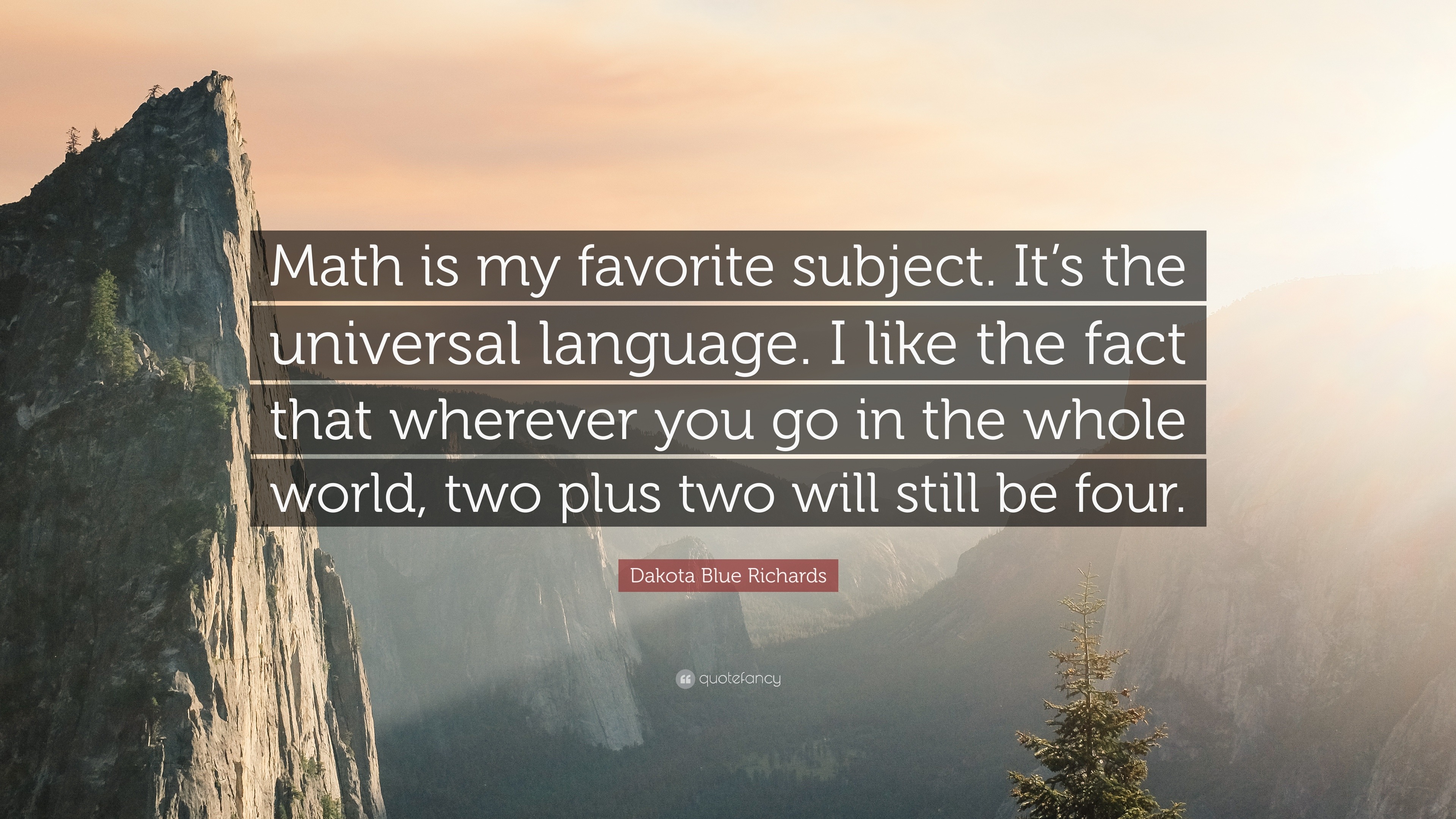
Mathematics has a rich history of innovation and discovery, and its future is equally promising. As a universal language, math will continue to play a vital role in shaping future technologies and scientific discoveries.
One of the most significant trends in mathematics is the increasing use of artificial intelligence (AI) and machine learning. AI-powered algorithms are already being used to solve complex problems in fields such as medicine, finance, and manufacturing. As AI continues to develop, it is likely to have an even greater impact on the way that mathematics is used.
Another emerging trend is the development of new mathematical theories and concepts. In recent years, there have been major breakthroughs in areas such as number theory, topology, and algebra. These new theories are providing new insights into the fundamental nature of mathematics and its applications.
Mathematics will also play a critical role in addressing global challenges such as climate change and sustainability. Mathematical models are being used to predict the effects of climate change and to develop strategies for mitigating its impact. Mathematics is also being used to design more efficient and sustainable technologies.
In addition to its practical applications, mathematics also has a profound impact on our understanding of the world around us. Mathematics helps us to make sense of the universe and to see the patterns that underlie all of reality.
Specific Examples of How Mathematics Has Been Used to Solve Real-World Problems
- The development of the calculus in the 17th century led to major advances in physics and engineering.
- The invention of the computer in the 20th century revolutionized the way that mathematics is used.
- Mathematical models are being used to predict the effects of climate change and to develop strategies for mitigating its impact.
- Mathematics is being used to design more efficient and sustainable technologies.
- Mathematics is helping us to understand the human genome and to develop new treatments for diseases.
Table Summarizing the Different Ways That Mathematics Is Used in Various Fields
| Field | Uses of Mathematics |
|---|---|
| Science | Modeling physical phenomena, analyzing data, making predictions |
| Engineering | Designing structures, developing new technologies, optimizing processes |
| Medicine | Developing new treatments, diagnosing diseases, analyzing medical data |
| Finance | Modeling financial markets, analyzing risk, developing investment strategies |
Timeline of Significant Mathematical Discoveries and Advancements
- 6th century BC: Pythagoras discovers the Pythagorean theorem.
- 3rd century BC: Euclid writes the Elements, a foundational work on geometry.
- 17th century: Isaac Newton and Gottfried Wilhelm Leibniz develop the calculus.
- 19th century: Évariste Galois develops Galois theory, a major breakthrough in algebra.
- 20th century: Alan Turing develops the Turing machine, a theoretical model of computation.
- 21st century: The development of AI and machine learning leads to new advances in mathematics.
Glossary of Key Mathematical Terms and Concepts
- Algorithm:A step-by-step procedure for solving a problem.
- Calculus:A branch of mathematics that deals with change.
- Equation:A mathematical statement that two expressions are equal.
- Function:A relation that assigns to each element of a set a unique element of another set.
- Geometry:A branch of mathematics that deals with the properties of space.
- Number theory:A branch of mathematics that deals with the properties of numbers.
- Proof:A logical argument that demonstrates the truth of a mathematical statement.
- Topology:A branch of mathematics that deals with the properties of space that are invariant under continuous deformations.
Short Story Illustrating the Power and Beauty of Mathematics
Once upon a time, there was a young girl named Alice who loved mathematics. She loved the way that numbers could be used to describe the world around her. One day, Alice was playing in the forest when she came across a strange creature.
The creature was shaped like a sphere, and it had no eyes, nose, or mouth. Alice was fascinated by the creature, and she asked it what it was.
The creature told Alice that it was a mathematical object called a sphere. It explained that a sphere is a three-dimensional shape that is perfectly round. Alice was amazed by the creature’s knowledge, and she asked it to teach her more about mathematics.
The universality of mathematics extends beyond cultural and linguistic boundaries, transcending the complexities of human languages. Just as what language is zulu can be spoken by people from different backgrounds, mathematical concepts and symbols hold a universal significance, enabling communication and understanding across diverse communities.
In this sense, mathematics can be considered a truly universal language, fostering a shared intellectual space where knowledge and ideas can be exchanged and disseminated without linguistic barriers.
The creature agreed, and it taught Alice all about the different branches of mathematics. Alice learned about algebra, geometry, calculus, and number theory. She also learned about the history of mathematics and the great mathematicians who had made important discoveries.
Alice was so fascinated by mathematics that she decided to become a mathematician herself. She went to college and studied mathematics, and she eventually became a professor at a university. Alice loved teaching mathematics to her students, and she inspired them to see the beauty and power of mathematics.
Math and Communication
Mathematics plays a pivotal role in communication, facilitating the exchange of ideas and information with precision and clarity. Its universal symbols and notations transcend language barriers, allowing for effective communication across cultures and disciplines.
One of the most significant applications of math in communication is in the field of coding. Mathematical algorithms form the foundation of error-correcting codes used in data transmission, ensuring the integrity of information sent over noisy channels. Cryptography, the art of secure communication, also relies heavily on mathematical concepts such as prime numbers and modular arithmetic.
Data Analysis
Math provides powerful tools for analyzing and interpreting data, enabling us to extract meaningful insights from complex datasets. Statistical methods, such as regression analysis and hypothesis testing, help us draw conclusions and make predictions based on observed data. Data visualization techniques, like graphs and charts, translate numerical information into visual representations, making it easier to communicate trends and patterns.
– Elaborate on the ethical considerations when applying math to real-world problems, such as fairness, transparency, and accountability.
The application of mathematics to real-world problems brings forth a range of ethical considerations that demand careful attention. These considerations include ensuring fairness, transparency, and accountability in the use of mathematical models and algorithms.
Fairnessconcerns the equitable distribution of benefits and burdens resulting from the application of mathematical techniques. It requires that algorithms and models do not exhibit bias or discrimination against specific groups or individuals.
Transparencyinvolves making the mathematical models and algorithms used in decision-making processes accessible and understandable to stakeholders. This allows for scrutiny and assessment of the underlying assumptions, methods, and potential biases.
Accountabilityensures that those responsible for developing and deploying mathematical models are held accountable for their ethical implications. This includes establishing mechanisms for reviewing and auditing algorithms, addressing unintended consequences, and mitigating potential harms.
Examples of Mathematical Techniques Used to Address Ethical Issues
- Fairness-aware machine learning algorithms: These algorithms are designed to mitigate bias and promote fairness in decision-making processes. They incorporate techniques such as data preprocessing, algorithmic adjustments, and post-processing to reduce disparities in outcomes.
- Explainable AI (XAI): XAI techniques provide explanations and insights into the decision-making process of machine learning models. This helps stakeholders understand the rationale behind predictions and identify potential biases or ethical concerns.
- Privacy-preserving data analysis: These techniques allow for the analysis of sensitive data while preserving the privacy of individuals. They employ methods such as anonymization, differential privacy, and secure multi-party computation to protect personal information.
Essential Questionnaire
Is math really a language?
Yes, math can be considered a language because it has its own symbols, syntax, and rules that allow for the communication of complex ideas and concepts.
Is math the only universal language?
While math is often referred to as the universal language of science and technology, it is not the only universal language. Music, art, and other forms of expression can also convey ideas and emotions that transcend cultural and linguistic barriers.
Are there any limitations to math as a language?
Yes, math has limitations in expressing certain concepts, such as emotions, subjective experiences, and qualitative aspects of human existence.
